Monday, May 21, 2012

Back to the New Testament

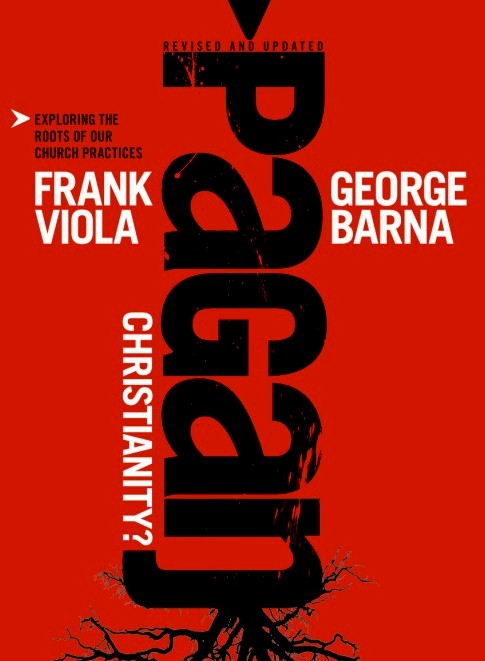
Pagan Christianity?: Exploring the Roots of our Church Practices by Frank Viola and George Barna

The basic thesis of this book is that traditional Christianity has adopted a number of practices that are not in the New Testament, and that these practices should be eliminated. When the authors refer to "traditional" Christianity, they mean both Protestant and Catholic churches - the critiques in this book are mainly directed to American evangelical churches. Sometimes Viola and Barna talk about the "institutional church", which they contrast to "organic" churches, or "house" churches, which are evidently preferable.

So what are these pagan practices? The authors focus on church buildings, paid clergy and sermons.

Perhaps the third one causes the most surprise - isn't there a lot of preaching in the Bible? There certainly is - but Viola and Barna argue that Old Testament prophets "spoke extemporaneously and out of a present burden, rather than from a set script" (p. 87), while what the New Testament apostles did is not normative for the Christian church. They planted churches and then moved on - and so the sermon is only appropriate for a church in its infancy. The biblical model for the church, our authors aver, is the full congregational participation as described in 1 Corinthians. In the same way, Viola and Barna argue that pastors simply get in the way of this every-member-ministry.

The book has a lot to say about how, particularly under Constantine, the church picked up ideas from the Graeco-Roman world. They also argue that the church carried over unhelpful things from its Jewish background. Thus, the church building is modelled on both the pagan shrine and the Jewish temple. The payment of clergy comes from both the paid Greek rhetoricians and the Levitical tithe. Clerical garments come from both Roman officials and Old Testament priestly garb. All these things, Viola and Barna argue, are not in the New Testament, and therefore do not belong in the church today.

There are two points, then - firstly, that these things are not in the New Testament, and secondly that it is wrong to practice them.

It is easy to think of New Testament verses about preaching. There is 2 Timothy 4:2 - "Preach the word; be ready in season and out of season..." But Viola and Barna say that this doesn't apply, because "Timothy was an apostolic worker" (p. 102). There is 1 Corinthians 9:14 - "In the same way, the Lord commanded that those who proclaim the gospel should get their living by the gospel." The authors don't deal with this verse - instead there is an annoying footnote on p. 178 that a "response to those biblical passages that some have used to defend clergy (pastor) salaries" can be found in Viola's book Reimagining Church. 

Actually, the authors reject the whole idea of "verses", and devote a whole chapter to critiquing the idea of prooftexts. They reject the idea that Acts 14:23 means that every church should have elders, since it "is referring to an event in south Galatia during the first century" (p. 235). They reject the idea that 1 Corinthians 16:2 supports a weekly offering since it's "dealing with a onetime request" (p. 236). Strangely, however, they do view 1 Corinthians 14:26 ("every one of you has a psalm") as normative (p. 166). 

The second point, then, is that it is wrong to do these things if they are not supported by the New Testament. Most Christians would agree that church buildings are not in the New Testament, but would think there is nothing wrong with them. Viola and Barna, however, argue that they "limit the involvement of and fellowship between members" (p. 44). 

This is a radically biblical approach to ecclesiology. It was strange, then, reading this as a Presbyterian. For the Westminster Confession of Faith affirms that God is not to be worshipped in any way "not prescribed in the Holy Scripture" (XXI.1). In this way, Viola and Barna are simply following the Regulative Principle of Worship, albeit with different emphases. For example, many proponents of the Regulative Principle use it to forbid musical instruments in worship. Viola and Barna note that "there is no evidence of musical instruments in the Christian church service until the Middle Ages" (p. 162) but they don't seem to view it as one of those evil, pagan practices. Now, the Confession distinguishes "elements" of worship, which always must be found in Scripture, and "circumstances" which "are to be ordered by the light of nature, and Christian prudence" (I.6). I have always thought instrumentation was one of those elements, as, indeed, church buildings would be. So I think we need to reject the argument that unbiblical practices are necessarily wrong.

Viola and Barna insist that we need to worship as they did in the first century, while at the same time reject the idea that the Book of Acts is a model for us. This strikes me as rather inconsistent. They emphasise the distinction between prescriptive and descriptive passages, but seem to privilege 1 Corinthians over Acts, seemingly without considering that the worship in 1 Corinthians (which has everyone sharing words of exhortation) may be merely descriptive as well. The great emphasis on preaching in Acts is simply discarded.

Finally, the rejection of pastors goes hand in hand with an anti-hierarchical approach. Viola and Barna appeal to Kevin Giles to back up their ideas. Giles has argued that the Son is not eternally subordinate to the Father. Yet the authors appeal to him and assert that historic orthodoxy rejects the eternal subordination of the Son (p. 264), without apparently realising the controversial nature of Giles' position, or the arguments against it.

Sunday, May 13, 2012

Film review: A Game of Shadows

Last week I bought the DVD of Sherlock Holmes: A Game of Shadows. This is the very first time I'd bought a DVD on its release date. I was not disappointed, however - the film is a worthy sequel to the first movie.

My favourite line in the film occurs when Holmes proposes a toast to Dr Watson, and says "To my dear friend, Dr John, um, Hamish Watson." Now, this is an extraordinary nod to the most die hard fans of the Holmes canon. You see, Arthur Conan Doyle never tells us Watson's middle name. He is referred to as John H. Watson", and it was Dorothy L. Sayers who proposed that the "H" stood for "Hamish."

Let me explain.A number of prominent writers have indulged in speculation about Sherlock Holmes. Sayers notes that this has been a particularly Christian exercise - in her book Unpopular Opinions, she says, "The game of applying the methods of the 'Higher Criticism' to the Sherlock Holmes canon was begun, many years ago, by Monsignor Ronald Knox, with the aim of showing that, by those methods, one could disintegrate a modern classic as speciously as a certain school of critics have endeavoured to disintegrate the Bible."

Conan Doyle refers to "John H. Watson" on the title page of A Study in Scarlet, but nowhere mentions his middle name. In The Man with the Twisted Lip, however, he has Watson's wife address him as "James". It would be too easy to say that the author made a mistake, so Sayers looks for a more elegant solution. She suggests that his middle name is Hamish, which is the Scottish form of James. "By playfully re-Englishing it to 'James' she found for her husband a pet-name which was his own name as well."

Obviously, Sayers wrote this with tongue in cheek. But I still find it amazing that this found its way into the movie, and the line was delivered with such subtlety as to bring delight to any fan of Sherlock Holmes, or, indeed, of Dorothy Sayers.

Rating: 3 ½ stars

Monday, May 07, 2012

Clunes Booktown

On Saturday we went to the Clunes Booktown. Clunes is a small town midway between Castlemaine and Ballarat, and every year it has a special book festival. We heard about it from Suzannah, and it had plenty of the vintage novels about which she likes to blog. We had a great time in Clunes, although the shops and stalls were not particularly pram-friendly. Here is what we bought:
  • Constantine and the Conversion of Europe by A. H. M. Jones
  • Misreadings by Umberto Eco
  • Two first editions by G. K. Chesterton - Alarms and Discursions and Tremendous Trifles
  • The Travels of Marco Polo - we were both interested in this after reading William Dalrymple's In Xanadu, which chronicles a journey that retraces Marco Polo's steps.
  • A book of stories by O. Henry
  • Brown Sunshine of Sawdust Valley by Marguerite Henry - Kara collects Henry's horse stories
  • The first two books of the Barchester Chronicles by Anthony Trollope - The Warden and Barchester Towers
  • A book which Clifton Fadiman edited containing, quite simply, his favourite pieces of writing
  • The Women of Israel by Grace Aguilar - This book was published in 1889. John is writing a thesis on the women in the Book of Samuel, and while this book doesn't cover all of them, it does have the wise women of Tekoa and Abel.
  • God's Gold: A Quest for the Lost Temple Treasures of Jerusalem by Sean Kingsley
  • Letters to Children by C. S. Lewis
  • The Colveneres of the Old Netherlands by C. C. Culvenor
  • The Southern States of North America by Edward King. London: Blackie & Son, 1875. Cr. 4o, 806pp.
  • Abraham Lincoln by Ingri and Edgar Parin d'Aulaire - winner of the 1940 Caldecott Medal.


Friday, March 09, 2012

Marked by grace

Real Marriage: The Truth about Sex, Friendship and Life Together by Mark and Grace Driscoll

Before one actually starts reading this book, one becomes aware that it is going to be controversial. The endorsement by Wayne Grudem at the front of the book alerts the reader to this, as does the warning in the preface not to read the book "as a critic trying to find where you think we might be wrong."

I can only assume the controversy concerns the chapter on which types of sexual activity are lawful (and/or helpful) to married couples.

The Driscolls do not cover every aspect of marriage in this book, but, of course – one cannot expect them to – marriage, as they say, is a many-splendoured thing. It is a hard subject on which to write a book, and authors must necessarily be selective about what they emphasise. The Driscolls note that most other marriage books neglect to talk about friendship between a husband and wife (p. 24) and so rightly devote a chapter to it.

The Driscolls have chosen, however, to write particularly about sex in marriage. The book is in no way salacious, and the Driscolls are correct to identify sex as a central part of marriage – even when it is missing.

Conversely, the Driscolls do not have as much to say about children in marriage. I wonder if this separates the topics of "marriage" and "family." (For those interested in reading more about the connection between sex and kids, I recommend "Sexual Opera" by Ben Merkle, in this issue of Credenda/Agenda.)

Most of the time the Driscolls only mention kids in passing – they rightly emphasise that one is a spouse before one is a parent (p. 214) and they rather dubiously frown on co-sleeping (p. 166). They also have something to say about birth control. I never expected to wish that Mark Driscoll was more forthright, but the authors call "potentially abortive birth control" (such as the Pill) "murky waters that are more difficult to discern for Christian couples" (p. 196). I would have called nonabortive birth control "murky waters". For potentially abortive birth control, I would have been much happier if the Driscolls simply told their readers not to use it, whereas they simply say that they stopped using it out of conscience many years ago (p. 197).

Finally, I must also mention that this book is intensely personal. The Driscolls have, I think, taken big risks in sharing their personal history, and – like Jesus – are practising intentional vulnerability for the sake of others.

Sunday, February 19, 2012

A taste of the Marrow: Nomista's testimony

I am currently reading The Marrow of Modern Divinity by Edward Fisher. It is a theological treatise written as a dialogue. This is a speech given by the character Nomista. The book raises the question of whether this person can be considered a Christian. What do you think, dear reader? I'd be very interested in your comments. I realise this quotation is rather long, but it is important to get the speech in full.

Sir, I having been born and brought up in a country where there was very little preaching, the Lord knoweth I lived a great while in ignorance and blindness ; and yet, because I did often repeat the Lord's prayer, the apostles' creed, and the ten commandments, and in that I came sometimes to divine service, as they call it, and at Easter received the communion, I thought my condition to be good. But at last, by means of hearing a zealous and godly minister in this city, not long after my coming hither, I was convinced that my present condition was not good, and therefore I went to the same minister, and told him what I thought of myself; so he told me that I must frequent the hearing of sermons, and keep the Sabbath very strictly, and leave off swearing by my faith and troth, and such like oaths, and beware of lying, and all idle words and communication ; yea, and said he, you must get good books to read on, as Mr. Dodd on the Commandments, Mr. Bolton's Directions for Comfortable Walking with God, Mr. Brinsley's True Watch, and such like ; and many similar exhortations and directions he gave me, the which I liked very well, and therefore endeavoured myself to follow them. So I fell to the hearing of the most godly, zealous, and powerful preachers that were in the city, and wrote their sermons after them ; and when God gave me a family, I prayed with them, and instructed them, and repeated sermons to them, and spent the Lord's day in public and private exercises, and left off my swearing, and lying, and idle talking ; and, according to exhortation, in few words, I did so reform myself and my life, that whereas before I had been only careful to perform the duties of the second table of the law, and that to the end I might gain favour and respect from civil, honest men, and to avoid the penalties of man's law, or temporal punishment, now I was also careful to perform the duties required in the first table of the law, and that to gain favour and respect from religious, honest men, and to avoid the penalty of God's law, even eternal torments in hell. Now, when professors of religion observed this change in me, they came to my house, and gave unto me the right hand of fellowship, and counted me one of that number : and then I invited godly ministers to my table, and made much of them ; and then, with that same Micah mentioned in the book of Judges, I was persuaded the Lord would be merciful unto me, because I had gotten a Levite to be my priest, Judges xvii. 13. In a word, I did now yield such an outward obedience and conformity to both tables of the law, that all godly ministers and religious, honest men who knew me, did think very well of me, counting me to be a very honest man, and a good christian ; and indeed I thought so of myself, especially because I had their approbation. And thus I went on bravely a great while, even until I read in Mr. Bolton's works, that the outward righteousness of the Scribes and Pharisees was famous in those times ; for, be- sides their forbearing and protesting against gross sins, as murder, theft, adultery, idolatry, and the like, they were frequent and constant in prayer, fasting, and alms-deeds, so that, without question, many of them were persuaded that their doing would purchase heaven and happiness. Whereupon I concluded, that I had as yet done no more than they ; and withal I considered, that our Saviour says, " Except your righteousness exceed the righteousness of the Scribes and Pharisees, ye cannot enter into the kingdom of God," Matt. v. 20; yea, and I also considered that the apostle says, "He is not a Jew that is one outwardly ; but he that is one inwardly, whose praise is not of men, but of God," Rom. ii. 28 29. Then did I conclude that I was not yet a true Christian ; for, Said I in my heart, I have contented myself with the praise of men, and so have lost all my labour and pains in performing duties ; for they have been no better than outside performances, and, therefore, they must all fall down in a moment. I have not served God with all my heart ; and, therefore, I see I must either go further, or else I shall never be happy. Whereupon I set about the keeping of the law in good earnest, and laboured to perform duties, not only outwardly, but also inwardly from my heart ; I heard, and read, and prayed, and laboured, to bring my heart, and forced my soul to every duty ; I called upon the Lord in good earnest, and told him, that whatsoever he would have me to do, I would do it with all my heart, if he would but save my soul. And then I also took notice of the inward corruptions of my heart, the which I had not formerly done, and was careful to govern my thoughts, to moderate my passions, and to suppress the motions and risings of lust, to banish pride and speculative wantonness, and all vain and sinful desires of my heart ; and then I thought myself not only an outside Christian, but also an inside Christian, and therefore a true Christian indeed. And so I went on comfortably a good while, till I considered that the law of God requires passive obedience as well as active : and therefore I must be a sufferer as well as a doer, or else I could not be a Christian indeed ; whereupon I began to be troubled at my impatience under God's correcting hand, and at those inward murmurings and discontents which I found in my spirit in time of any outward calamity that befel me ; and then I laboured to bridle my passions, and to submit myself quietly to the will of God in every condition ; and then did I also, as it were, begin to take penance upon myself, by abstinence, fasting, and afflicting my soul ; and made pitiful lamentations in my prayers, which were sometimes also accompanied with tears, the which I was persuaded the Lord did take notice of, and would reward me for it ; and then I was persuaded that I did keep the law, in yielding obedience both actively and passively. And then was I confident I was a true Christian, until I considered, that those Jews, of whom the Lord complains, Isa. Iviii. did as much as I ; and that caused me to fear that all was not right with me as yet. Whereupon I went to another minister, and told him that though I had done thus and thus, and suffered thus and thus; yet was I persuaded, that I. was in no better condition than those Jews, O-yes! said he ; you are in a better condition than they : for they were hypocrites, and served not God with all their hearts as you do. Then I went home contentedly, and so went on in my wonted course of doing and suffering, and thought all was well with me, until I bethought myself, that before the time of my conversion, I had been a transgressor from the womb ; yea, in the womb, in that I was guilty of Adam's transgression : so that I considered that although I kept even with God for the time present and to come, yet that would not free me from the guiltiness of that which was done before ; whereupon I was much troubled and disquieted in my mind. Then I went to a third minister of God's holy word, and told how the case stood with me, and what I thought of my state and condition. He cheered me up, bidding me be of good comfort: for how- ever my obedience since my conversion would not satisfy for my former sins ; yet, inasmuch as, at my conversion, I had confessed, lamented, deplored, bewailed, and forsaken them, God, according to his rich mercy and gracious promise, had mercifully pardoned and forgiven them. Then I returned home to my house again, and went to God by earnest prayer and supplication, and besought him to give me assurance of the pardon and forgiveness of my guiltiness of Adam's sin, and all my actual transgressions before my conversion ; and as I had endeavoured myself to be a good servant before, so I would still continue in doing my duty most exactly ; and so, being assured that the Lord had granted this my request, I fell to my business according to my promise ; I heard, I read, I prayed, I fasted, I mourned, I sighed, and groaned ; and watched over my heart, my tongue, and ways, in all my doings, actions, and dealings, both with God and man. But after a while, I growing better acquainted with the spiritualness of the law, and the inward corruptions of my own heart, I perceived that I had deceived myself, in thinking that I had kept the law perfectly ; for, do what I could, I found many imperfections in my obedience ; for I had been, and was still subject to sleepiness, drowsiness, and heaviness, in prayers and hearing, and so in other duties; I failed in the manner of performance of them, and in the end why I performed them, seeking myself in everything I did: and my conscience told me I failed in my duty to God in this, in my duty to my neighbour in that. And then I was much troubled again : for I considered that the law of God requires, and is not satisfied without, an exact and perfect obedience. And then I Went to the same minister again, and told him how I had purposed, promised, striven, and endeavoured, as much as possibly I could, to keep the law of God perfectly ; and yet by woful experience I had found, that I had, and did still transgress in many ways ; and therefore I feared hell and damnation. " Oh ! but," said he, " do not fear ; for the best of Christians have their failings, and no man keepeth the law of God perfectly ; and therefore go on, and do as you have done, in striving to keep the law perfectly ; and in what you cannot do, God will accept the will for the deed; and wherein you come short, Christ will help you out." And this satisfied and contented me very much. So I returned home again, and fell to prayer, and told the Lord that now I saw I could not yield perfect obedience to his law, and yet I would not despair, because I did believe that what I could not do Christ had done for me : and then I did certainly conclude, that I was now a Christian indeed, though I was not so before : and so have I been persuaded ever since. And thus, sir, you see I have declared unto you, both how it hath been with me formerly, and how it is with me for the present ; wherefore I would entreat you to tell me plainly and truly what you think of my condition.

Tuesday, January 31, 2012

Rednecks redacted

Deer Hunting with Jesus: Dispatches from America's Class War by Joe Bageant

I found this book completely by accident. I was looking for Paul Fussell's Class: A Guide Through the American Status System, which had been discussed on the Basement Tape on "class". Fussell wasn't there, but this book was, and it looked interesting. It's a review of right-wing working-class white American (i.e. redneck) culture, written by a liberal for liberals, presumably so they can better understand their fellow countrymen. An excellent summary of the ideas in the book is in Bageant's article, "Why rednecks may rule the world."

Most of the book is about redneck poverty: many have unrealistic mortgages weighing them down, and many have to contend with enormous medical bills. But the most interesting chapters are the ones about guns and religion - which form, of course, the inspiration for the book's title. Unfortunately, Bageant lumps together premillennialists and reconstructionists, dismissing the differences with an airy "I will spare you the agony of fundamentalist taxonomy." But he makes an amazing claim about R. J. Rushdoony: if the United States experiences a fourth "Great Awakening", historians may one day document it as beginning in 1973 with the publication of The Institutes of Biblical Law.