Sunday, December 30, 2012

25 books John plans to read in 2013

I have done similar listings for the last three years. I have finished eighteen books of the twenty I listed last year, which was an improvement on previous years. So I'm upping the ante and listing twenty-five instead of twenty.

My book pile. The only book I am yet to get is Leepike Ridge.
Novels: 
Pigs Have Wings by P. G. Wodehouse ✔Much better than expected - the best of the Blandings books

This will be, I think, my 20th Wodehouse book. It's one of the Blandings series, which are not nearly as good as either Jeeves or Mulliner.

A Case of Conscience by James Blish

This seems to have been the inspiration behind Mary Doria Russell's superb novel The Sparrow. A Jesuit priest is sent to investigate an alien race.  

Leepike Ridge by N. D. Wilson ✔Wonderful story - read the review

I read five novels by N. D. Wilson this year, and all of them were excellent. I have not reviewed them here, but I agree with pretty much everything Suzannah said on her blog. Anyway, this book is an earlier work, but I just can't get enough of this author.
Persuasion by Jane Austen ✔Brilliant!

I have read three Jane Austen novels now - Emma, Pride and Prejudice and Mansfield Park. I aim to finish them all before I turn forty, at which point I plan to start on the Russians. This is Kara's favourite Austen novel.

Derwood, Inc. by Jeri Massi ✔Simply charming

This is another of Kara's favourite books. I read Massi's Secret Radio when it was serialised on her blog several years back, but this is of a very different genre.

Treasure Hunt by Frederick Buechner ✔A fitting end to a fascinating series
The is the final installment of the Bebb tetralogy. I read the first three books many years ago, and have been re-reading them over the last few years.

Theological books:

Reformation and Scholasticism: An Ecumenical Enterprise

Reformed scholasticism is not talked about that much. It is barely covered in theological seminaries, and even the Wikipedia article was only created a few weeks ago. I'd like to learn move about all this.
Introduction to Old Testament Theology: A Canonical Approach by John Sailhamer ✔Heavy going at time, but quite helpful

I have a special interest in canonical approaches to the Bible.

Piety and the Princeton Theologians by W. Andrew Hoffecker ✔Insightful
Thoughts on Religious Experience by Archibald Alexander

The Princetonians are attractively unfashionable these days. But I remember hearing Iain Murray speak years ago and suggest that one might make a special study of them the way Martyn Lloyd-Jones made a special study of the Puritans.
The Bible in the University ✔Patchy, but held my interest
This is in the same series as Canon And Biblical Interpretation, which I read last year.

The Federal Vision and Covenant Theology: A Comparative Analysis by Guy Prentiss Waters ✔Not very good - read the review

The author is coming to PTC next year for an MA intensive subject on Romans. The subject of this book is an important one, especially since the PCV recently appointed a committee to investigate Federal Vision theology and report back to next year's Assembly.

Other Christian books:
Ascent to Love: A Guide to Dante's Divine Comedy by Peter Leithart ✔A helpful introduction

 I've read several of Leithart's books now, and I always find him stimulating and biblical. I plan to re-read the Divine Comedy again this year, perhaps in real time over Easter. The Inferno begins on Maundy Thursday, and ends on Easter Sunday, while the Paradiso takes place on Easter Wednesday. I should also point out that the Divine Comedy is set when the author was 35 ("Midway this way of life we're bound upon"), and I will be turning 35 this year.
Dying We Live: The Final Messages and Records of the Resistance ✔Engaging and illuminating

I plan to make this my Lenten reading for next year.

The Prophetic Imagination by Walter Brueggemann

This is a book about applying biblical theology to Christian ministry - looking at how a pastor is to be like a prophet.

This Odd and Wondrous Calling: The Public and Private Lives of Two Ministers by Lillian Daniel and Martin B. Copenhaver ✔Interesting, but too liberal to be really helpful

This is another book about pastoral ministry, in which the authors share their thoughts and experiences.  One of the authors, it must be noted, is a woman.
The Life and Diary of David Brainerd ✔Inspiring

I don't often read diaries, and I don't often read missionary biographies either - I think the last one I read was John G. Paton's Autobiography, and that was three years ago. But I've been meaning to read Brainerd for a while, and I was reminded of it again recently while reading David Platt's Radical.
The Philosophy of Science and Belief in God by Gordon H. Clark ✔Hard to follow
Gordon H. Clark: Personal Recollections ✔Strange - read the review

I don't know very much about Gordon Clark - I guess I think of him only as the guy who disagreed with Cornelius Van Til on some things.

Miscellaneous:

The Writing Life by Annie Dillard ✔More on life than on writing, but that was OK

Kara and I read Dillard's  Pilgrim at Tinker Creek last year, separately, and this year read An American Childhood together. Both were excellent.

The Well-Trained Mind: A Guide to Classical Education at Home by Susan Wise Bauer  ✔Useful, but frustratingly secular
 Another book to help me think through homsechooling, most likely in some form of the classical tradition.

The History of Rasselas, Prince of Abissinia by Samuel Johnson
Boswell's Life of Johnson

Another pairing - I have been meaning to read Boswell's Life of Johnson for ages, and thought that I might as well read a book by Johnson at the same time.

Utopia by Thomas More
Thomas More's Magician: A Novel Account of Utopia in Mexico by Toby Green

I came across Thomas More again recently in Chesterton's A Short History of England: "He was above all things a Humanist and a very human one. He was even in many ways very modern, which some rather erroneously suppose to be the same as being human; he was also humane, in the sense of humanitarian." Green's book relates the account of Vasco de Quiroga, who was inspired by the book to attempt the construction of a utopia in Mexico.

Saturday, December 29, 2012

Kara's Reading Goals for 2013

Here are twelve books I plan to read in 2013, paired in categories.

Two books on unfamiliar topics:


The Four by Peter Leithart Finished in July

Referring to the gospels, of course.

Joy at the End of the Tether by Douglas Wilson

This is one of three books the author recommends one read to figure out what makes him tick. It's about the book of Ecclesiastes.

Two books that were presents:


They Found a Cave by Nan Chauncy Finished in January

A children's story, set in Tasmania.

The Dean's Watch by Elizabeth Goudge

When I read this, I will have completed the City of Bells series.

Two books about writing:


Wordsmithy by Douglas Wilson Finished in July

I love the subtitle: "Hot tips for the writing life".

The Writing Life by Annie Dillard
 

Two books about parenting:


Standing on the Promises by Douglas Wilson Finished

Perhaps this should be in the "ought to have read" category. Somehow I skipped this when I first read the family series.

Fit to Burst by Rachel Jankovic Finished

Rachel's first book, Loving the Little Years, was full of humour and practical tips. I look forward to more of the same in this.

Two books I ought to have read before:


The Pilgrim's Progress by John Bunyan Finished

I have decided that practically memorizing a dramatized audio version when I was a child still doesn't count as reading the book.

Leepike Ridge by N. D. Wilson Finished in February

Because after reading  the 100 Cupboards trilogy and the first two installments of the Ashtown Burials, I want to read everything Wilson has written.

Two memoirs:


Chesterton's Autobiography  Finished

A Severe Mercy by Sheldon Vanauken

Friday, December 21, 2012

A view from outside the Christian Patriarchy Movement

Quiverfull: Inside the Christian Patriarchy Movement by Kathryn Joyce

This is a book I could scarcely put down. It describes the Christian patriarchy (also known as "Biblical patriarchy") movement, which is something I am interested in, know a bit about, and to some extent identify with.

The book has three sections. The first section ("Wives") deals with the "biblical womanhood" movement, which emphasises wives submitting to and helping their husbands at home. The second section ("Mothers") looks at the "Quiverfull" movement, which eschews contraception and emphasises a couple having as many children as God will give them. The name of the movement comes from Psalm 127 - "Like arrows in the hands of a warrior are children born in one’s youth / Blessed is the man whose quiver is full of them". The final section ("Daughters") deals with biblical courtship, while also touching on the "Stay At Home Daughters" movement, exemplified by Anna Sofia and Elizabeth Botkin, and their book So Much More. This emphasises girls staying at home (and more importantly, under their fathers' authority) until marriage.

The title of the book is therefore a bit misleading, but the subtitle is accurate - all these three things come broadly under the heading of "Christian patriarchy". However, it must be pointed out that the author is not a Christian. Joyce doesn't seem to understand what "faith" is - she feels that the Christian hymn "Trust and Obey" is bleak (p. 154). She mentions Bible verses that adherents of patriarchy would appeal to, but has no real ability to interact with them. And yet, where the reader may have expected antagonism, Joyce is surprisingly dispassionate. She devotes a chapter to the story of a lady who was excommunicated from Doug Phillips' church, and tells only her side of the story, but is still not wholly sympathetic to her, and the chapter ends with this lady firing her divorce lawyer for failing to abide by her wishes (p. 129). Excommunication appears a few times in this book, and Joyce refers to an interesting Wall Street Journal article on the subject. She doesn't seem to realise, however, that pulpit announcements about church discipline have always been part of Reformed liturgy.

The worst feature of the book is the complete and utter lack of footnotes. This is totally inexcusable for a book like this, and I don't know how the publisher (Beacon Press, which belongs to the Unitarian Universalist Association) let her get away with it. Yes, the book is mostly the fruit of personal interviews, but Joyce is still constantly quoting published material. For example, she refers to a book (The Church is Israel Now) that argues for "replacement theology", and she asserts that "Christian reviewers condemned the book for promoting a form of theological anti-Semitism" (p. 150). Well, which reviewers? Who was it? My guess is that the reviewers would be premillenial dispensationalists themselves.

Quiverfull also contains numerous silly mistakes. Joyce claims that when Al Mohler became President of Southern Baptist Theological Seminary, he required all the faculty to pledge allegiance to the Westminster Confession of Faith (p. 34). What Mohler enforced, of course, was the Abstract of Principles, which, while derived from the WCF, differs from it in affirming believers' baptism by immersion. Joyce also says that Pope Benedict XVI "canonized an Italian farmer's wife for bearing twelve children" (p. 141). Joyce is referring to Eurosia Fabris, except that Fabris was beatified, not canonized, and she had eleven children, not twelve, and two of her children were adopted.

Perhaps the most bizarre claim of the book comes when Joyce attempts to link the Quiverfull movement with holocaust denial - she sees both the movement and the Holocaust as "manipulating population as a means of cultural domination, whether through limiting one group's freedom or ability to reproduce or mandating higher fertility from another group" (p. 150).

Finally, this book is almost exclusively focused on the movement in America, apart from discussions of population decline in Europe, and of conservatism in Poland. Now, when Joyce suggests that most Quiverfull families are poor (p. 206), this may well be the case in the U.S., but in Australia the situation would be quite different. My calculations based on this website tell me that a low-income Australian family with eight children under 16 would receive about $1200 per week in family payments, which is over $60,000 a year. The only catch is that (as of last July) you are required to have your children immunized. Hence, no-one in Australia can really say that they cannot afford to have more children.

By and large, Quiverfull is a fair portrayal of the Christian patriarchy movement, and most adherents of the ideas would be able to recognise themselves in the descriptions of people in the book. The movement is quite diverse, even theologically, embracing Reconstructionists, Fundamentalists and Pentecostals. Joyce is antagonistic to the movement, but often sympathetic to the individual women she interviews. Yet one feels that she is not sure quite what to make of her subject matter. In fact, she concludes the book by describing a woman in the movement, and frankly admitting "I don't know what to make of her" (p. 240). In this way, however, the reader is delivered from a heavy-handed evaluation, and is free to make up his or her own mind.

Tuesday, December 11, 2012

Not that radical

Radical: Taking Back Your Faith from the American Dream by David Platt

As requested, a review of this challenging and encouraging book.

This is an American book, and, as the subtitle suggests, Platt is specifically addressing Americans, and wealthy, middle-class Americans at that. Of course, greed and discontent are known in all cultures, and the goals of possessions, one's own home and a comfortable retirement are also common here in Australia. But it is a bit strange to hear statements like "Few Christians know of C. T. Studd (p. 178), or even that John Paton (whom I dressed up as once) is "relatively unknown among Christians today" (p. 175). Well perhaps, these men are relatively unknown, but no doubt they are better known in my circles than in Platt's.

Despite the title, this really is a book about the ordinary Christian life. Yes, following Jesus is radical, because he requires allegiance to him above all things, but there is little in this book beyond the basics of Christian living. But that doesn't detract in any way from the book's value.

I particularly liked Platt's questioning of the phraseology of "accepting" Jesus (p. 37), when, in fact, we need Jesus. I also liked his description of our purpose as being to "enjoy his grace and extend his glory" (p. 65) - which is basically like the first question and answer of the Westminster Shorter Catechism ("Man's chief end is to glorify God, and to enjoy him for ever") - though interestingly in reverse order.

The most disappointing aspect of this book was that he begins the book by reflecting on megachurches, but never returns to the idea. He starts off by wondering how he could reconcile the fact that he was pastoring thousands, with the fact that Jesus "spent the majority of his ministry time with twelve men" (p. 2). Yet, the radical discipleship described in the book doesn't seem to touch the concept of megachurches. Now, I have no doubt that Platt is a faithful pastor, teaching, encouraging and equipping the people of God to faithfully follow Jesus. But it would seem that he was convicted that the concept of megachurches do not faithfully represent what Jesus was on about, but is happy to continue as a megachurch pastor. If so, this is a significant blind spot.

I also wonder if there is still an individualistic streak running through the book, when Platt rejects the idea that "God loves me" is the essence of biblical Christianity, and "improves" the statement to read "God loves me so that I might make him known" (p. 70). That is an improvement, certainly, but is still an imperfect summary of biblical Christianity. It would be better to say "God loves his people..." or, better still, "God loves his people in Christ".

In summary, this is an enjoyable book. Platt is a faithful pastor, and communicates effectively through apposite illustrations. It is also a stimulating and challenging book, even for this Australian.

Saturday, June 09, 2012

The Five Points of Calvinism: Normalized, Notarized and Novelized

A Journey in Grace by Richard P. Belcher

This book was a whole lot better than expected. It is an exposition of the five points of Calvinism is the form of a novel. The narrator is a seminary student who is introduced to Calvinism while starting to pastor a church and also courting a girl. The book is intentionally didactic, but a lot less cheesy than one might fear. In fact, it is one of the most readable introductions to Calvinism I have come across.

Of course, there is much more to Calvinism than just the five points, but the book does touch, albeit tangentially, on the doctrines of Scripture and the Church. Besides, this is just the first volume in a series of more than a dozen books. I should also point out that the book is written in a decidedly Baptist context - by a Baptist and for Baptists.

Anyway, if any reader is wondering what the five points of Calvinism actually are, I will quote a post I wrote on the subject on my old blog:

T stands for Total Depravity which says that before I got saved I was a helpless sinner who couldn't lift a finger for his own salvation.

U stands for Unconditional Election, which says that God chose me before the creation of the world, not because of any inherent goodness I had, not because he foresaw that I would believe, but simply because he loved me.

L stands for Limited Atonement which says that Christ died to pay for my sins, and he really did pay for them fully and completely. He didn't just make it possible for me to be saved, he actually saved me.

I stands for Irresistible Grace which says that the Holy Spirit is completely powerful and that he was strong enough to overcome my sin and my unbelief.

P stands for Perseverance of the Saints, which says that I can't lose my salvation because God will protect me and prevent me from denying him.

Monday, June 04, 2012

Reading the OED by Ammon Shea

I find the concept of this book slightly annoying. On the front cover of my edition is the boast, "I have read the OED so you don't have to." Is this meant as a dare? Because any word lover worth his salt isn't going to be satisfied with such a claim. How are we to know that the author has found the most interesting words?  I feel like going to the library right now and taking down Volume 1: A to Bazouki.

The book is the story of the author's reading through the massive Oxford English Dictionary in one year. The chapters are titled according to the letters of the alphabet and contain a smattering of the  words he discovered along the way. This brings me to my second criticism. Half the fun of the OED is the detailed histories of words. And all that is missing in this book. The definitions provided are sadly brief, and occasionally misleading. (At least Shea admits to this in his introduction.) The entry for Balaamite is particularly disappointing. It seems to be an attempt at humor at the expense of the Bible, and it's quite evident that Shea didn't bother to look at the story in any depth. But this was mild in comparison to the worldly-wise anti-marriage scoff tagged on to the definition for opsigamy.

These gripes aside, I still couldn't resist a book about reading books, and it was a fun read in the main.

Will I add any of the words I read about to my vocabulary? Probably not---well, maybe abluvion. I see that a lot.

Monday, May 21, 2012

Back to the New Testament

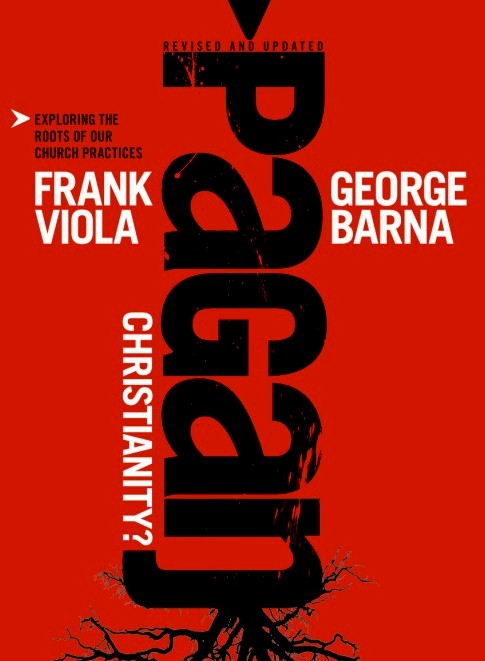
Pagan Christianity?: Exploring the Roots of our Church Practices by Frank Viola and George Barna

The basic thesis of this book is that traditional Christianity has adopted a number of practices that are not in the New Testament, and that these practices should be eliminated. When the authors refer to "traditional" Christianity, they mean both Protestant and Catholic churches - the critiques in this book are mainly directed to American evangelical churches. Sometimes Viola and Barna talk about the "institutional church", which they contrast to "organic" churches, or "house" churches, which are evidently preferable.

So what are these pagan practices? The authors focus on church buildings, paid clergy and sermons.

Perhaps the third one causes the most surprise - isn't there a lot of preaching in the Bible? There certainly is - but Viola and Barna argue that Old Testament prophets "spoke extemporaneously and out of a present burden, rather than from a set script" (p. 87), while what the New Testament apostles did is not normative for the Christian church. They planted churches and then moved on - and so the sermon is only appropriate for a church in its infancy. The biblical model for the church, our authors aver, is the full congregational participation as described in 1 Corinthians. In the same way, Viola and Barna argue that pastors simply get in the way of this every-member-ministry.

The book has a lot to say about how, particularly under Constantine, the church picked up ideas from the Graeco-Roman world. They also argue that the church carried over unhelpful things from its Jewish background. Thus, the church building is modelled on both the pagan shrine and the Jewish temple. The payment of clergy comes from both the paid Greek rhetoricians and the Levitical tithe. Clerical garments come from both Roman officials and Old Testament priestly garb. All these things, Viola and Barna argue, are not in the New Testament, and therefore do not belong in the church today.

There are two points, then - firstly, that these things are not in the New Testament, and secondly that it is wrong to practice them.

It is easy to think of New Testament verses about preaching. There is 2 Timothy 4:2 - "Preach the word; be ready in season and out of season..." But Viola and Barna say that this doesn't apply, because "Timothy was an apostolic worker" (p. 102). There is 1 Corinthians 9:14 - "In the same way, the Lord commanded that those who proclaim the gospel should get their living by the gospel." The authors don't deal with this verse - instead there is an annoying footnote on p. 178 that a "response to those biblical passages that some have used to defend clergy (pastor) salaries" can be found in Viola's book Reimagining Church. 

Actually, the authors reject the whole idea of "verses", and devote a whole chapter to critiquing the idea of prooftexts. They reject the idea that Acts 14:23 means that every church should have elders, since it "is referring to an event in south Galatia during the first century" (p. 235). They reject the idea that 1 Corinthians 16:2 supports a weekly offering since it's "dealing with a onetime request" (p. 236). Strangely, however, they do view 1 Corinthians 14:26 ("every one of you has a psalm") as normative (p. 166). 

The second point, then, is that it is wrong to do these things if they are not supported by the New Testament. Most Christians would agree that church buildings are not in the New Testament, but would think there is nothing wrong with them. Viola and Barna, however, argue that they "limit the involvement of and fellowship between members" (p. 44). 

This is a radically biblical approach to ecclesiology. It was strange, then, reading this as a Presbyterian. For the Westminster Confession of Faith affirms that God is not to be worshipped in any way "not prescribed in the Holy Scripture" (XXI.1). In this way, Viola and Barna are simply following the Regulative Principle of Worship, albeit with different emphases. For example, many proponents of the Regulative Principle use it to forbid musical instruments in worship. Viola and Barna note that "there is no evidence of musical instruments in the Christian church service until the Middle Ages" (p. 162) but they don't seem to view it as one of those evil, pagan practices. Now, the Confession distinguishes "elements" of worship, which always must be found in Scripture, and "circumstances" which "are to be ordered by the light of nature, and Christian prudence" (I.6). I have always thought instrumentation was one of those elements, as, indeed, church buildings would be. So I think we need to reject the argument that unbiblical practices are necessarily wrong.

Viola and Barna insist that we need to worship as they did in the first century, while at the same time reject the idea that the Book of Acts is a model for us. This strikes me as rather inconsistent. They emphasise the distinction between prescriptive and descriptive passages, but seem to privilege 1 Corinthians over Acts, seemingly without considering that the worship in 1 Corinthians (which has everyone sharing words of exhortation) may be merely descriptive as well. The great emphasis on preaching in Acts is simply discarded.

Finally, the rejection of pastors goes hand in hand with an anti-hierarchical approach. Viola and Barna appeal to Kevin Giles to back up their ideas. Giles has argued that the Son is not eternally subordinate to the Father. Yet the authors appeal to him and assert that historic orthodoxy rejects the eternal subordination of the Son (p. 264), without apparently realising the controversial nature of Giles' position, or the arguments against it.