I recently eliminated comment moderation on this blog--partly because there haven't been any comments to moderate! Also, maybe it will make it easier for those of you who don't like waiting for me to check my e-mail (which is usually at least once in a blue moon!) .
However, I still have "anonymous" comments disabled. I like to know who I'm talking to...even if it's a pseudonym. Being anonymous looks like the first step to being a snake in the grass, anyway!
How about suggestions for a more interactive blog? I don't mean to sound stand-offish--do I come across that way? It's hard for me to think of interesting questions to ask.
Comments, please?
Friday, November 10, 2006


An Apology for Story
This is a paper I wrote for a local homeschooler's gathering. I presented it last night, and decided to post it here as well...
An Apology for Story
Apology: A formal justification, defense. A desire to clear the grounds for some course, belief, or position.1
Story: a connected series of events, real or imagined, with a common theme.2
Story: a connected series of events, real or imagined, with a common theme.2
Story. It is something we’ve all grown up with. Some of my earliest memories are of snuggling up close to my daddy, listening as he spun a tale of childhood—of playing cowboys and Indians with neighborhood children, of hearing the early morning clatter of pots and pans as Grandma cooked breakfast.
Later, my mother would spend hours reading to me. I followed Laura Ingalls across the open prairies, chanted the rhymes of Dr. Seuss and rejoiced when Peter Rabbit didn’t get his milk and berries.
As I learned to read on my own, I discovered that there truly is no “frigate like a book,”3 to take me to worlds unknown. I have never traveled beyond the borders of my homeland in the flesh. But in my mind, I can taste the tang of salty ocean breezes, see the rugged beauty of the Scottish highland, and traverse the staggering expanse of the Arabian Desert. I have friends from every age and every race. I know peasants, knights, farmers, painters, explorers and kings.
Books, but especially storybooks, have become integral and vital parts of my everyday life.
Imagine my surprise when one day I learned that it is not so for many people. For many, reading stories is considered to be an occasional luxury, or even as something to be shunned.
Imagine my amazement when one day I read that “modern Christians have forgotten the art of storytelling.”4 It truly is a sad loss. When I see bookstore shelves filled with the disposable cotton candy that is storytelling today, I wonder why.
As I pondered these disturbing facts, I began to wonder if it is because we have forgotten the importance of story. And even more importantly, whether we’ve forgotten the Storyteller.
Have you ever wondered why God chose to communicate to us in the way He did? He could have given us a list of the “Top 10 things you need to know about life.” He could have given us an encyclopedia of important facts. But instead, He told us a story. A story so incredible that it would sound like a fairy tale, if we didn’t know it was true. God’s book is a gripping tale of Paradise Lost, of a “poisoned” fruit, and a generational curse. It’s a story of a captive maiden saved by a knight in shining armor. It’s a tale of epic battle between a king and a wicked dragon. It’s about the beggar girl who marries the prince.5
Why read stories? We read stories because it is the natural way that we, as humans, learn. As Douglas Wilson wrote, “when it comes to having a need to orient all beliefs within a story, mankind is incorrigible…We do this for the same reason that we stick to the ground when we walk—this is how our Creator decided to do it.”6 A story takes abstract, dead ideas and resurrects them into vibrant life.
It sounds novel, but it’s true: I have learned more from stories than from sermons, lectures or textbooks. This is because through stories I see an author’s worldview fleshed out. My view of life is expanded, and I see the world through new eyes.
It is easy to unthinkingly absorb the ideas of our age, to allow our mental vision to become narrow and self-centered. But in books, the distance between our time and the wisdom of the past becomes only a thin veil.7 In books, my mind steps from it’s own small box and moves into the realm of wise men. This is how we escape the modern foible that C.S. Lewis called “Chronological Snobbery,”8 that prideful idea that we have all the answers and therefore have no need to learn from the past.
Stories don’t have to have a moral spelled out to be valuable. In fact, I admire authors who respect their readers enough to let them find the lessons for themselves. C.S. Lewis, speaking of writing for children, said, “Let the pictures tell their own moral. For the moral inherent in them will rise from whatever spiritual roots you have succeeded in striking during the whole course of your life.”9 He brought up a point that is worth dwelling on. No art form is neutral. It is inevitable that an author’s worldview will be laced throughout every word he puts on paper. As Christians, we need to be acutely conscious of this and look at every story through the glass of the Greatest Story.
This is the starting point in appreciating great stories. How familiar are you with God’s story? Do you know the Author of that Story? If not, don’t leave tonight and grab Alice in Wonderland off the shelf.10 We need to get our priorities straight: put first things first, and become totally immersed in the waters of God’s word.
Once a person has done this, an exciting thing happens. He can begin to use his imagination to fulfill through story the mandate that God has given to live in His image, to be fruitful and to take dominion over the earth.11 J.R.R. Tolkien’s theory of “subcreation” is built upon this premise. An important aspect of this type of writing is the use of “eucatastrophe”, that is, the happy ending in the midst of overwhelming odds. “Eucatastrophe” is the opposite of tragedy, something that is unthinkable for the Christian. Tolkien, in his essay entitled “On Fairy-Stories” described his idea of eucatastrophe as a “sudden and miraculous grace…. it denies….universal final defeat and in so far is evangelium, giving a fleeting glimpse of Joy, Joy beyond the walls of the world…”12
Stories are important to me. They can be beautiful, thoughtful, and extremely influential.
My desire is that someone here in my audience would be inspired to see, first of all, God’s word, and then other books, in a new light. I hope someone here will begin to read more widely and to write stories to the glory of God.
I’ll close with a quote by Douglas Wilson: “…this is the fundamental theology of story. God so loved the world that He sent His Son. And God so loved the world that He told us the story of what He had done. And so should we.”13
Notes:
1Websters New Collegiate Dictionary (G & C Merriam Co., 1974), 53
2My own summary of various definitions.
3Robert N. Linscott, Selected Poems & Letters of Emily Dickinson (Anchor Books, 1959), 184
4Douglas Wilson, “Love Story.” Credenda/Agenda, Volume 15, Issue 6:4
5Genesis 3; Isaiah 27:1, 54:5-6; Revelation 19:11-16, 20:1-10
6Douglas Wilson, 4
7Metaphor inspired by Elizabeth Yates, Nearby (New York: Coward-McCann Inc., 1947), 46
8Walter Hooper, C.S. Lewis: A Companion and Guide (Harper San Francisco, 1996), 553-554
9 C.S. Lewis, “On Three Ways of Writing for Children,” in Of Other Worlds: Essays and Stories (New York: Harcourt, Brace & World, Inc., 1966), 33
10No insult to Lewis Carrol implied. I highly appreciate his stories.
11Genesis 1:28; Colossians 3:17
12J.R.R. Tolkien, quoted in Tom Shippey, J.R.R. Tolkien:Author of the Century (Boston: Houghton Mifflin, 2000), 211
13Douglas Wilson, 4
Copyright 2006 Kara J. Alumbaugh
Friday, October 27, 2006
Good Stories: An interview with my family
Several weeks ago, I posted a favorite Theodore Roosevelt quote: “I am in the mood for a good story. Of course, I am always in the mood for a good story.”
As I posted it, I began to wonder “what is a good story?” It was a question I’d never really pondered before. I know I love a good story, but the qualities that define a good story have never really come into the forefront of my thoughts.
I decided to do a little survey of my family members. Interestingly, no one brushed me off saying, “who cares?” or “it doesn’t really matter”. Story is important to us.
First I headed to my bedroom, where sister Tine was busy typing up her latest tale. She didn’t hesitate at all to answer my question, emphatically stating: “A good story is exciting. It has a little bit of everything—something funny, something serious. It’s true to life. It doesn’t make you wish you lived somewhere else. But fairies are OK sometimes. Most mysteries I don’t like. I write my books the way I wish other books had been written.” She turned back to her own story.
This was promising! I left to get my mother’s opinion. It was characteristically brief: “A good story is humorous and true to life.”
I had to dig a little to get taciturn Matt to answer, but once he did, he expressed ideas that are a common thread throughout all the responses I’ve received so far: “ It’s intriguing and holds your interest. It has a good plot and storyline. Not boring!”
I had to giggle when I heard Timmy’s ideas: “No kissing. No walking around talking about nothing. There should be bears and snowballs.” How like all little boys!
This was too good to keep to myself. I was telling Mommy about it when Daddy walked in. Pencil in hand, I again asked “what makes a good story?” He didn’t have to think long: “A good story has human interest. It stirs your emotions.” Probing, I asked which ones. “You’ll get a good laugh. Be moved with compassion.” The conversation took a lofty turn. “A good story shows you the brevity and value of life. You experience life’s joys. A good story takes you to places you’ve never been to meet people you’d not otherwise meet.”
It was the next day before I could ask busy college-going brother A. It was possibly a reflection of his current workload when he immediately said, “A good story keeps me awake. It has a combination of good dialogue, mystery, adventure, comedy, tragedy, and love.” (We’re not talking to a 9-year-old now!) “A story has to have all elements of life. Love and hate. You can’t understand one without the other."
Being an interviewer is fun. You can ask all the questions you want, and never have to give any answers. I won’t be so provoking as that. However, I will postpone the moment of my own answer!
It’s time for you, my reader, to respond. What features of a story draw you in? What are things that make you want to read a book again? Negatively, what things about a story repel you? I’m thinking of fiction in particular, but the question could apply to nearly any type of book. Remember, “story” is simply a connected series of events.
As I posted it, I began to wonder “what is a good story?” It was a question I’d never really pondered before. I know I love a good story, but the qualities that define a good story have never really come into the forefront of my thoughts.
I decided to do a little survey of my family members. Interestingly, no one brushed me off saying, “who cares?” or “it doesn’t really matter”. Story is important to us.
First I headed to my bedroom, where sister Tine was busy typing up her latest tale. She didn’t hesitate at all to answer my question, emphatically stating: “A good story is exciting. It has a little bit of everything—something funny, something serious. It’s true to life. It doesn’t make you wish you lived somewhere else. But fairies are OK sometimes. Most mysteries I don’t like. I write my books the way I wish other books had been written.” She turned back to her own story.
This was promising! I left to get my mother’s opinion. It was characteristically brief: “A good story is humorous and true to life.”
I had to dig a little to get taciturn Matt to answer, but once he did, he expressed ideas that are a common thread throughout all the responses I’ve received so far: “ It’s intriguing and holds your interest. It has a good plot and storyline. Not boring!”
I had to giggle when I heard Timmy’s ideas: “No kissing. No walking around talking about nothing. There should be bears and snowballs.” How like all little boys!
This was too good to keep to myself. I was telling Mommy about it when Daddy walked in. Pencil in hand, I again asked “what makes a good story?” He didn’t have to think long: “A good story has human interest. It stirs your emotions.” Probing, I asked which ones. “You’ll get a good laugh. Be moved with compassion.” The conversation took a lofty turn. “A good story shows you the brevity and value of life. You experience life’s joys. A good story takes you to places you’ve never been to meet people you’d not otherwise meet.”
It was the next day before I could ask busy college-going brother A. It was possibly a reflection of his current workload when he immediately said, “A good story keeps me awake. It has a combination of good dialogue, mystery, adventure, comedy, tragedy, and love.” (We’re not talking to a 9-year-old now!) “A story has to have all elements of life. Love and hate. You can’t understand one without the other."
Being an interviewer is fun. You can ask all the questions you want, and never have to give any answers. I won’t be so provoking as that. However, I will postpone the moment of my own answer!
It’s time for you, my reader, to respond. What features of a story draw you in? What are things that make you want to read a book again? Negatively, what things about a story repel you? I’m thinking of fiction in particular, but the question could apply to nearly any type of book. Remember, “story” is simply a connected series of events.
The Keeper of the Bees by Gene Stratton-Porter
Gene Stratton-Porter didn’t know that this would be the last book she’d write. She couldn’t have known that shortly after finishing the last draft she would die tragically in a trolley-car collision in Los Angeles.
Yet somehow as I read “Keeper” I felt as if she was preaching her last sermon. Anyone who reads Porter’s books knows that her personal beliefs about home, family and life are clearly seen. But perhaps never so thinly clad behind the storybook characters as here. She speaks passionately on topics ranging from belief in God and prayer to healthy eating and premarital chastity.
There’s a lot about bees, too. In fact, the main character, James Lewis MacFarlane, spends a great deal of time tending hives and listening to the fascinating tales of bee life told by his young partner, little Scout.
As the story opens, Jamie is a sickly, disillusioned soldier recuperating from injuries received in the Great War. Although his physical body is very frail, his spiritual body is suffering even more. Bitter at the suffering he’d seen and experienced in war, he has nearly forgotten God and is completely and morbidly absorbed in himself.
Convinced he is about to die, when the chance comes to do one last deed for someone else, he accepts it readily. And this selfless act is the beginning of his Great Adventure.
Often, there is an overly melodramatic and sentimental tone which I dislike in books of this period (1900-1925). Despite this stylistic fault, I found the book to be pleasantly thought provoking and worth my time. I finished reading it more appreciative of nature and with some issues to ponder.
If you’ve never experienced the unique books of Gene Stratton-Porter, start with Laddie or Freckles first. These are the books which I consider to be her masterpieces. Once you’ve read them, don’t neglect The Keeper of the Bees!
Saturday, September 30, 2006
Chance to win books and other goodies!
Kim is sponsoring a contest on her blog: Guess how many products will be in the new Vision Forum Catalog, and you could win over $700 worth of merchandise.
VF is a great place to get good books with a Christian worldview. So take a guess...it might be worth your while. :)
Click here for the details.
VF is a great place to get good books with a Christian worldview. So take a guess...it might be worth your while. :)
Click here for the details.
Friday, September 29, 2006
My sentiments exactly
I am in the mood for a good story. Of course, I am always in the mood for a good story.
--Theodore Roosevelt
--Theodore Roosevelt
Wednesday, September 20, 2006
Summer Miscellany
It was a summer of books and tomatoes.
Books first. (Does this reflect my priorities?)
By far the best and most encouraging book of the season was The Lighted Heart by Elizabeth Yates. I have always enjoyed her books, and can appreciate them more than ever, now that I know some of her life story. Early in their marriage, her husband found that, after suffering weak eyes for many years, he would soon become blind. Wanting to make the most of the last remaining sighted months, Elizabeth and Bill moved to a secluded New England farm. During that first year, they made many special memories together as they restored the old farmhouse, cleared the land, planted a garden, and tapped their maple trees. When Bill did eventually lose his sight, they found new challenges ahead, but never lost the joy of living.
In telling her story, Ms. Yates did not gloss over the fact that life is filled with trials, and perhaps this is why I found the book so compelling. The troubles were not seen as roadblocks, but rather as opportunities. One thing I have always admired in Elizabeth Yates’ writing is her ability to describe her characters’ world so that it seems as real in my mind as it must have been in her own. Knowing that her husband was blind gives me insight into how she perfected this skill.
Do Butlers Burgle Banks? Of course they do…at least in this title by P.G. Wodehouse. Sadly, the promising storyline falls flat. No zip, no verve…no hilarious conversations—all things I have come to expect of this author. Perhaps he was at his best when writing about the characters he knew best. Very Good, Jeeves! bears this out. It is almost hard to believe that it was written by the same author.
I don’t always read normal books. Sometimes a good picture book is a refreshing alternative. Like the The Little Mouse, the Red Ripe Strawberry and the Big Hungry Bear by Don Wood Since my little sister received it as a baby, it has become one of our most favorite read-aloud books. Bright pictures, a cute storyline, and few words (always a plus!) make it a quite fun to read, especially with one or two small children in your lap.
A new find in children’s books this year was Wait til the Moon is Full by Margaret Wise Brown. It is a good example of the use of repetition.
I love the art of N.C. Wyeth. So of course I was excited to see The Collected Paintings, Illustrations and Murals in a stack of books my dad brought home from the library. Like Norman Rockwell, Wyeth’s paintings always tell a story.
And then there was The Magic of M.C. Escher. If you haven’t seen his prints, look some up. They will amaze you. He was big into optical illusion and the mathematical side of art.
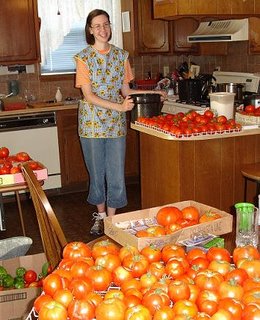
If I do a book by book description, this will become the long instead of short summary. So I’ll move on to the tomatoes. And other vegetables. You can’t make salsa without ‘em. A joint effort on the part of my family to preserve summer’s bounty for a later date concluded with the sight of cabinets filled with jars of salsa, spaghetti sauce, peach jam, apple butter and other tasty things. As you can see by the picture, I don’t always have my nose in a book!
And so concludes the short summary of a short summer. The family school is back into session, and I’m helping by teaching history, writing, vocabulary, music and logic. I will attempt the occasional blog post… but until I figure out a better “schedule” (horrors!), my posting may be quite sporadic.
Books first. (Does this reflect my priorities?)
By far the best and most encouraging book of the season was The Lighted Heart by Elizabeth Yates. I have always enjoyed her books, and can appreciate them more than ever, now that I know some of her life story. Early in their marriage, her husband found that, after suffering weak eyes for many years, he would soon become blind. Wanting to make the most of the last remaining sighted months, Elizabeth and Bill moved to a secluded New England farm. During that first year, they made many special memories together as they restored the old farmhouse, cleared the land, planted a garden, and tapped their maple trees. When Bill did eventually lose his sight, they found new challenges ahead, but never lost the joy of living.
In telling her story, Ms. Yates did not gloss over the fact that life is filled with trials, and perhaps this is why I found the book so compelling. The troubles were not seen as roadblocks, but rather as opportunities. One thing I have always admired in Elizabeth Yates’ writing is her ability to describe her characters’ world so that it seems as real in my mind as it must have been in her own. Knowing that her husband was blind gives me insight into how she perfected this skill.
Do Butlers Burgle Banks? Of course they do…at least in this title by P.G. Wodehouse. Sadly, the promising storyline falls flat. No zip, no verve…no hilarious conversations—all things I have come to expect of this author. Perhaps he was at his best when writing about the characters he knew best. Very Good, Jeeves! bears this out. It is almost hard to believe that it was written by the same author.
I don’t always read normal books. Sometimes a good picture book is a refreshing alternative. Like the The Little Mouse, the Red Ripe Strawberry and the Big Hungry Bear by Don Wood Since my little sister received it as a baby, it has become one of our most favorite read-aloud books. Bright pictures, a cute storyline, and few words (always a plus!) make it a quite fun to read, especially with one or two small children in your lap.
A new find in children’s books this year was Wait til the Moon is Full by Margaret Wise Brown. It is a good example of the use of repetition.
I love the art of N.C. Wyeth. So of course I was excited to see The Collected Paintings, Illustrations and Murals in a stack of books my dad brought home from the library. Like Norman Rockwell, Wyeth’s paintings always tell a story.
And then there was The Magic of M.C. Escher. If you haven’t seen his prints, look some up. They will amaze you. He was big into optical illusion and the mathematical side of art.
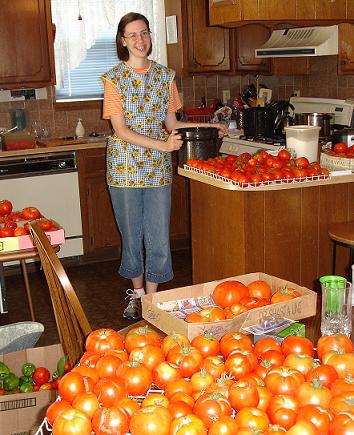
If I do a book by book description, this will become the long instead of short summary. So I’ll move on to the tomatoes. And other vegetables. You can’t make salsa without ‘em. A joint effort on the part of my family to preserve summer’s bounty for a later date concluded with the sight of cabinets filled with jars of salsa, spaghetti sauce, peach jam, apple butter and other tasty things. As you can see by the picture, I don’t always have my nose in a book!
And so concludes the short summary of a short summer. The family school is back into session, and I’m helping by teaching history, writing, vocabulary, music and logic. I will attempt the occasional blog post… but until I figure out a better “schedule” (horrors!), my posting may be quite sporadic.
Subscribe to:
Posts (Atom)