Monday, May 24, 2010

John's May Reading

Currently Reading:

Brave New Family: G. K. Chesterton on Men and Women, Children, Sex, Divorce, Marriage and the Family

I am giving a talk on Chesterton at St Joseph's Catholic Church, Chelsea on Thursday, 2nd September at 7:30pm. This is a wonderful collection of pieces, recently compiled. This morning I read "The Library of the Nursery," where Chesterton argues that children do not really need books of Nonsense. "Sages and grey-haired philosophers," to be sure, "ought to sit up all night reading
Alice in Wonderland," but
The child has no need of nonsense: to him the whole universe is nonsensical, in the noblest sense of that noble word. A tree is something top-heavy and fantastic, a donkey is as exciting as a dragon. All objects are seen through a great magnifying-glass; the daisy in the meadow is as large as a tree of the Hesperides, and the pebbles littered about a puddle will serve for the Islands of the Blest.

Christ and Culture by Klaas Schilder

I have been thinking through the issue of common grace in preparation for my talk on Abraham Kuyper at the Religion in the Public Square colloquium, and I thought this would be an opportunity to finally have a go at reading this book. Much of what Schilder wrote on the subject of culture and grace is a response to Kuyper's ideas:
We are fog-bound. Even the followers of Dr. Abraham Kuyper are. For years and years they talked of nothing but “God’s honour in all spheres of life.” The more scholarly ones among them constantly repeated Kuyper’s adage concerning “sphere sovereignty.” Every “sphere” of “life” had its own “sovereignty. However; often they do no more than repeat this slogan. No wonder. For Abraham Kuyper himself could not clearly explain what exactly those “sovereigns” in all those “spheres” are. One single Sovereign—that we can accept and understand But as soon as one starts to speak about “sovereigns” in the plural, each of them in his own sphere, then things become vague.

I've been greatly blessed in the past by reading Schilder's trilogy on the suffering and death of Christ. Those were rich meditations, but difficult to read - it literally took me years to get through the three books. So far,
Christ and Culture seems to suffer from the same sort of lack of readability.

Passage by Connie Willis

I don't often re-read books, but this one is just so good. It's about a couple of researchers who manage to simulate near-death experiences. This is a gripping story, and Willis is most adept at getting the reader to identify with the main characters.

Reading the Old Testament by John Barton

As many readers will know, I am starting to specialise in the Old Testament in my reading and study, and this book provides a good introduction to the different types of approaches and "criticisms" out there. I have found it useful in writing the Wikipedia article on canonical criticism.


Finished Recently:

Three Views on the New Testament Use of the Old Testament

This was a difficult read, and it's hard to explain what are the three views in question. They revolve around fulfilment of Old Testament prophecies. For example, Matthew 2:15 indicates that certain events in Jesus' life "fulfilled what the Lord had said through the prophet: Out of Egypt I called my son." This is a quotation of Hosea 11:1. Now, as I understand them, Walter Kaiser would say that Hosea was revealed a truth about the Messiah, Darrell Bock would understand the passage as talking about God's Son, but that Jesus as well as Israel, fulfils that role, while Peter Enns would say that Hosea was not thinking about Christ at all, but since the whole of the Old Testament has Christ as the goal, it was reasonable of Matthew to make the connection.

This has been a burgeoning area of study in recent years, as witnessed by the massive
Commentary on the New Testament Use of the Old Testament, which I often use in sermon preparation.

The Clown in the Belfry: Writings on Faith and Fiction by Frederick Buechner

Last time I blogged, I mentioned how I was reading
Buechner's The Book of Bebb. I thought it would be appropriate to read some of his non-fiction at the same time. This is a collection of sermons and addresses. The title of the book comes from an anecdote about a certain Lyman Woodard who "stood on his head in the belfry with his feet toward heaven." That, says Buechner, "is a magical and magnificent and Mozartian thing to do."

Quitting Church: Why the Faithful are Fleeing and What to Do about It by Julia Duin


This book is about those who quit church, for such reasons as being hurt by a church, not being able to find good teaching, or not having churches take singleness seriously. Interestingly, one of the reasons covered is charismatics not being able to find a suitable church, since so many charismatic churches have, in recent years, moved away from exercising the extraordinary gifts.

Searching the Scriptures - A Feminist Introduction


The world of feminist hermeneutics is a desolate one, and I would not recommend venturing there without good reason. The essays in this book seem to be based on two premises: 1) the Bible is intensely patriarchal; 2) that's a bad thing. Still, the book wasn't quite as bad as I expected.

Monday, April 12, 2010

Kara's March and April Reading

Finished:

A Girl at Government House, An English Girl's Reminiscences: "Below Stairs" in Colonial Australia, ed. by Helen Vellacott

Recently, I was talking with one of the ladies at church about Kansas and Victorian history. I gave her Pioneer Women; she gave me this. What a fun read it was! It's an edited version of a book published anonymously many years ago. Helen Vellacott found an old copy in a bookshop and liked the story so much that she researched until she found the name of the author. This edition has illustrations and photos of many of the people and places mentioned in the story. It's the memoir of a girl who left England for Australia in the 1890's, and ended up working in the kitchens of several prominent leaders of the day.

Pride and Predator by Sally S. Wright

Second in a series. Dorothy Sayers wannabe, Wright, gives us a story of a Scottish minister killed by bees. I didn't like this nearly as much as Publish and Perish. But that might not have so much to do with the book, as with the fact that I'm a minister's wife.

Changing Planes
by Ursula Le Guin

This collection of short stories soon lost its attraction for me. What began as an intriguing idea (people stranded in airports visiting other "planes") soon flopped, as the stories began to look like anthropological studies. I've since been told that this probably wasn't the best Le Guin to start with.

Bobby Brewster's Ghost by H.E. Todd

Two reasons I took this took this from the shelf: I wanted to read a book that John had read as a child. And my littlest brother had just read it, and given me an enthusiastic report. It was a fun way to spend an afternoon.

Currently reading:

Reformed is not Enough by Douglas Wilson

The Federal Vision book. And I still don't see what the big deal is. I've found the discussion of living by faith in the chapter entitled "Reformation Bona Fides" particularly helpful. I'm still thinking on this: "systematic interpretations may be allowed to interpret what the Scriptures say...but they must never be allowed to replace what the Scriptures say. We can tell we have stumbled at this place when we disallow (for the sake of our systematic understanding) a phrase or statement that the Bible itself uses." (p.54) I'm afraid I've done that before.

The Dream of Scipio by Iain Pears

I'm halfway through and I still don't know what's going on. But somehow I feel compelled to finish.

Immortal Lovers: Elizabeth Barret and Robert Browning by Frances Winwar

John, Tony (my brother in law) and I were out walking the other day when our attention was drawn to a sign: Book sale, 100m. A little later, there was another: Book sale, 50m. By now, we were excited! This is one of the books I came home with. (John and Tony found several useful Bible commentaries)

Prodigal Press by Marvin Olasky

Not certain one of the major premises is entirely accurate. (Did the U.S. ever have any Christian reporting? Or was it simply that newspapers used the accepted phraseology of the day?) But still a very insightful study on journalism past and present, with a helpful discussion of the ethical issues at stake.

BookSneeze Review: Jane Austen by Peter Leithart

In this slim biography (only 175 pages), Peter Leithart endeavours to counter misconceptions of the "Divine Jane" and to reveal Austen as she was. He shows how her life was idealized in the 19th century, and compares letters quoted in older biographies with the originals. Leithart argues that Austen's satiric, sometimes cutting, sense of humour has been often downplayed or ignored. The Victorian Austen was "an Austen who could never even deign to notice bad breath, much less complain about it to her sister." (page 146)

He also comments on the current craze for all things Austen, labelling it "Janeia". He says that "Jane Austen is now what she never was in life, what what she would have been horrified to become--a literary celebrity." (back cover) Instead, he believes that she was a humble person: "She recognized her own smallness, and she achieved artistic greatness because she recognized her limitations and joyfully worked within them...." (page 153)

I've not read many biographies of Austen, so am not sure if Leithart is really saying anything new. But I found the book a concise, balanced introduction to her life, and a useful companion to Leithart's excellent commentary on Austen's novels, Miniatures and Morals.

Note: Originally, the book was written as part of the Cumberland Press Leaders in Action series, however, publication was delayed when the press went out of business last year. Thankfully, Thomas Nelson decided to print it as part of their Christian Encounters series. I was thrilled to receive a review copy from Booksneeze .

Saturday, March 13, 2010

John's March Reading

Currently Reading:

Intentional Disciplemaking: Cultivating Spiritual Maturity in the Local Church by Ron Bennett

I am reading this book as part of discussion group with my fellow PTC graduates.

Biblical Economics: A Commonsense Guide to Our Daily Bread by R. C. Sproul, Jr.

This is an informative book. Sproul is very critical of U.S. governmental policy, and accuses it of stealing, not so much through high taxation, but through currency devaluation and excessive borrowing. It's not quite as biblical as I would like: perhaps a better title would be Austrian Economics.

Reading Biblical Narrative by J. P. Fokkelman

This is one of the classics in the field. I find the recent trend towards literary approaches in biblical studies to be quite satisfying.

The Book of Bebb by Frederick Buechner

This volume consists of a quartet of novels, the first three of which I read about ten years ago. I bought this book recently, and decided I wanted to re-read them all before I got to the one I haven't read yet. They are about a so-called evangelist named Leo Bebb, who runs a mail-order ordination business. Buechner describes his physical appearance in the following terms:
A workable, Tweedledum mouth with the lines at the corners, the hinge marks, making an almost perfect H with the tight lips. A face plump but firm, pale but not sick pale. He was high-polish bald and had hardly a trace of facial hair, beard or eyebrows even. The eyes were jazzy and wide open and expectant, as if he'd just pulled a rabbit out of a hat or was waiting for me to.

Finished Recently:

Handbook
of Church Discipline: A Right and Privilege of Every Church Member by Jay Adams

As the title suggests, this is a practical manual of the way in which biblical discipline should be carried out in the church. And as the subtitle indicates, the great theme of this book is that discipline is a blessing that we dare not withhold from God's people.

One of the unusual arguments in the book is that there is a difference between excommunication and "putting outside the fellowship". In the former, the offending party is still regarded as a brother, while in the latter situation, he is regarded as a "tax collector or sinner".

A Wizard of Earthsea
by Ursula Le Guin

Another classic that for years I'd never got around to reading. Completely enchanting.

Visions & Voyages: The Story of Celtic Spirituality by Fay Sampson

This book's subtitle is a little misleading, as the book has much more to do with the history of Celtic Christianity than its "spirituality". But it contains a whole lot of great stories and fascinating characters.

Biffen's Millions and The Return of Jeeves by P. G. Wodehouse

These are both the U.S. titles. They were published in the U. K. under the titles Frozen Assets and Ring for Jeeves respectively. Light-hearted fun.

Tuesday, February 23, 2010

Kara's February Reading

Blue Like Jazz by Don Miller

Girl Meets God by Lauren Winner

Two spiritual autobiographies that made me think. The first is by a man who ended up a Christian, in spite of early experiences of Fundamentalism gone bad. He challenged my ideas of what evangelism and friendship with non-Christians should look like. This must be the sort of book Kafka was talking about: "I think we ought to read only books that bite and sting us. If the book we are reading doesn't shake us awake like a blow to the skull, why bother reading it in the first place?" (read the rest of the quote here)

I loved Girl Meets God. In it, Lauren Winner tells of her conversion from Orthodox Judaism to Christianity. She brings home to me the truth that following Christ costs something. I appreciated how her story is neither glib nor saccharine, and how she doesn't gloss over the many intellectual struggles she had along the way. I hope to read more from this author--Mudhouse Sabbath next, I think.

For the Children's Sake by Susan Schaeffer Macaulay

I've been vaguely familiar with aspects of Charlotte Mason's education theory for some time now. Things like reading aloud, narration, and nature study. But I've wanted to learn more. So I was happy to find this introduction to her thought on our shelves. I found myself arguing with the book as I read, and even after finishing I don't really understand the ideas behind the method.

In spite of this, I did glean some helpful things. I appreciate the admonition to parents to not act like they have all the answers, and to make sure that the children know that their parents are under authority, too. Of particular interest to me was the idea that I can help children now, even if I don't have any of my own. Being willing to listen, perhaps reading aloud to a child in the neighbourhood.

Chocolat by Joanne Harris

I was deeply disappointed in this book. After seeing and liking the movie, I expected a book that revelled in the delights of chocolate while exploring themes of prejudice, friendship and hypocrisy in religion. Well, I got the themes. But not much chocolate. Which is almost infuriating, considering the book's title! I was left feeling a bit depressed and confused. I couldn't identify with any of the characters at any meaningful level. Who was I supposed to feel for? The snooty, prejudiced townspeople? The rootless chocolatier who dabbles in witchcraft? The fanatical priest with a hidden past? The story seems to be saying that life is better when we throw away prejudice, help those in need, and do what we like (never mind what society thinks). Maybe there's some element of truth buried somewhere in there. But when I reached the end of the book, I was thinking of the emptiness and futility of life without Christ.


The Flying Inn by G.K. Chesterton

Great for someone who already likes Chesterton, but not for anyone else. Too episodic. He's not really much of a novelist. Lots of speeches, poetry and story all mixed up together.

The "Song of Right and Wrong" is often quoted at our house.

Monday, February 15, 2010

John's February Reading

Currently Reading:

The Unprejudiced Palate: Classic Thoughts on Food and the Good Life by Angelo Pellegrini

This book, first published in 1948, is a memoir/reflection on cooking and eating by an Italian immigrant to the US. He reacts angrily to the culinary élite who suggest that "excellent meals require exotic and unavailable ingredients, endless hours in the kitchen and a lifetime to perfect" (page 10). Instead, Pellegrini extols the virtues of simple fare and growing one's own vegetables.

Unpopular Opinions by Dorothy Sayers

This volume contains some of Sayers' best pieces, such as "Christian Morality" and "A Vote of Thanks to Cyrus". Most of these I'd read before - indeed, several of them are reprinted in Letters to a Diminished Church, which I bought a few years ago. That latter volume, however, was terribly edited, and inexplicably omitted the first half of the address "Creative Mind". Anyway, I particularly enjoyed reading "The Gulf Stream and the Channel", which muses on how Britain's geography may affect its culture.

Mansfield Park by Jane Austen

This is my third Austen novel, having read Emma and Pride and Prejudice. So far, it seems to have an inordinate number of introductory chapters.

The Liturgical Year by Joan Chittister

I received a review copy of this book through Book Sneeze. Stay tuned for a full-length review.


Finished Recently:

Visit the Sick: Ministering God's Grace in Times of Illness by Brian Croft


This is the second book I have read in DayOne's inexpensive and helpful Ministering the Master's Way series.

On the Banks of Plum Creek by Laura Ingalls Wilder

Kara is reading this series aloud to me - this is the fourth book we've read.

Through Painted Deserts by Donald Miller

I really like this guy. This book left me wanting more.

Four Gospels, One Jesus: A Symbolic Reading by Richard Burridge

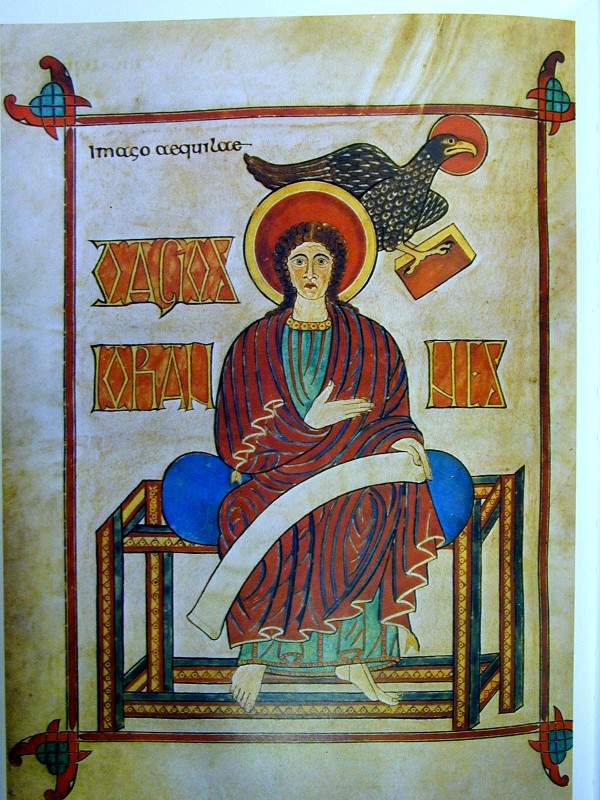
This book compares the four biblical gospels. Burridge takes as his starting point the traditional portraits of the Evangelists: Matthew is traditionally represented by a man, Mark by a lion, Luke by an ox and John by an eagle, as pictured in the Lindisfarne Gospels:

Burridge, however, give these representations a new twist: he considers these images as ones the evangelists use of Jesus. Thus, Mark portrays Jesus as a lion who bounds across the stage - "the lion bounds on, roars, and bounds off again, calling us to see him, in Galilee, somewhere." Luke, on the other hand, portrays Jesus as an ox, plodding steadily toward being sacrificed.

Although it can be overdone, we do need to recognise the differences between the gospel accounts, and avoid flattening them out into one "Life of Christ" narrative. I learned a lot of things in this book about the subtle differences between the gospels. For example, whereas Luke uses the words "joy" and "rejoice" numerous times, in Mark's gospel they're only used once each - in 4:16, when the seed on rocky ground receives the word "with joy," and in 14:11 when the chief priests rejoice over Judas' betrayal. That is to say, Mark's theology is one of "suffering and darkness".

Friday, February 05, 2010

Kara's January Reading

These will all be in the category of Finished Recently, as the month is already over...

The Paideia of God by Douglas Wilson

This is a collection of essays on classical education. Not the sort of book to spend a lot of time mulling over, rather, more bits to fit into my growing concept of Biblical education. Best essays: Title, and one discussing whether the Reformed faith and Classical education are necessary counterparts.

One Flesh: A Practical Guide to Honeymoon Sex and Beyond by Amelia and Greg Clarke

This is the first book I've finished from my list of books to read in 2010. As I read it, I asked myself whether I would recommend it to someone preparing for marriage. I've concluded that it wouldn't be my first choice. There's too much detail in some places (i.e. discussion of various positions-- possibly overwhelming, I think, for newly-weds) and not enough detail in others. I would have liked to have seen more discussion of what to expect on the wedding night, and how to prepare. Anyway, for pre-wedding reading about love making, I would recommend selected chapters from Ed Wheat's Intended for Pleasure.

My friend Sherrin has written a more detailed review of this book here.

Asterix the Legionary

My first Asterix comic. And so far my favourite. I knew I had to read these when John started making little jokes, and then remarking that they were "from Asterix". Since the "Legionary", I've also read Asterix in Spain, Asterix in Britain and Asterix the Gaul. I like the funny names and wordplay.

The Worst Case Scenario Survival Handbook: Travel by Joshua Piven and David Borgenicht

If I ever need to trail a pickpocket, survive a trip down a waterfall, get out of a locked car trunk, or cross a piranha-infested river, I'll know what to do!

Paddington Marches On by Michael Bond

Not the best, but still fun revisiting a childhood favourite.

Soul Survivor: How My Faith Survived the Church by Philip Yancey

Another from the 2010 list. This one made me think. At times, there was so much food for thought that I had to put it down for a few days, just so I could digest it all. Often I found myself getting uncomfortable; other times I began having a spirited debate with some of the ideas promoted by authors Yancey discusses.

In the past year, I've learned not to be afraid to ask hard questions. Soul Survivor gave me many to ponder: What sorts of civil disobedience are Biblical? In what ways has the Church alienated people unnecessarily? What does it mean to love sinners? And many more. This is an important book for me, one I'm still thinking about weeks after I finished reading it.