Monday, October 28, 2013

Once again, brilliant Christian story-telling

Empire of Bones by N. D. Wilson

This is the third volume in the Ashtown Burials series. Reviews of this book are a little superfluous. If you have read the first two, you will want to read Empire of Bones, and you will love it. If you haven't read any book in the series yet, you will need to start with The Dragon's Tooth.

Yet I do need to say something about how I love this series so much, and the recent publication of this volume is an excellent opportunity to do so. I want to mention five important themes in the series, that came out in the book in particular.

Firstly, the series is distinctly Christian, and this became slightly more explicit in this book (e.g. p. 333). There is an atonement of sorts, and it has a similar feel to that of The Lion, the Witch and the Wardrobe.

Secondly, as Suzannah Rowntree has astutely pointed out, the Order of Brendan in the book series is used as a metaphor of the Church. This is developed a bit more in Empire of Bones, and we start to see the fuzzy edges of the concept, such the existence of different denominations, and the presence of people who view the Order as a club rather than a calling (p. 313).

Thirdly, Wilson draws heavily on the Old Testament's Book of Daniel. The central character of the book is a boy named Cyrus, who (like his biblical namesake) is a Messiah-figure. His brother, Daniel, is a prophetic figure, and the book contains a significant prophecy about "seventy weeks".

Fourthly, Wilson explores the theme of death in this series, and especially this book. Again and again reference is made to the blessing of mortality. As one transmortal character is told (p. 103), "You fall and you rise and you fall again, but your inner war can never leave off, it can never stay won. Mortals weren't made for it. We were made to run and hit the finish." This is also something that Wilson has been exploring in his non-fiction writing – see this video, for example.

Fifthly, this book is strong on the theme of family, especially fatherhood. There are lots of interesting family dynamics and exploration of the differences between girls and boys (e.g. p. 142).

Finally, I detected a couple of interesting influences in N. D. Wilson's writing that I hadn't seen before. The other day I happened upon a review he had written of Thomas Cahill's How the Irish Saved Civilization many years ago. Wilson had sounded convinced, and his appreciation of Celtic Christianity comes through in Empire of Bones. Also,there is a hint of the Eastern Orthodox concept of the "Holy Fool" (p. 430).

Empire of Bones is brilliant writing. Wilson draws on a wide range of sources, but so much of it is original. This is an imagination most fertile.

Sunday, October 06, 2013

The perilous and exciting doctrine of Sola Scriptura

The Shape of Sola Scriptura by Keith A. Mathison

Sola Scriptura ("Scripture alone") was one of the slogans of the Reformation. According to Mathison, it is the idea that the Bible alone is the ultimate source of authority. This book explains what the doctrine is, and also what it isn't, and Mathison says some things that will come as a surprise to many readers. I, for one, learned a lot while reading it.

In the first place, Mathison convincingly argues that Sola Scriptura was not a Reformation innovation. On the contrary, it was the Roman Catholic view of tradition that was the new idea. The Council of Trent states thatsaving truth, and moral discipline... are contained in the written books, and the unwritten traditions which, received by the Apostles from the mouth of Christ himself, or from the Apostles themselves, the Holy Ghost dictating, have come down even unto us, transmitted as it were from hand to hand.” Yet this idea of unwritten apostolic tradition really only comes from the 12th century  a mere 400 years before the Reformation. 

Mathison argues that the doctrine has four components:
    1. Scripture is the sole source of revelation
    2. Scripture is the final authoritative norm of doctrine and practice
    3. Scripture is to be interpreted in and by the Church
    4. Scripture is to be interpreted according to the Rule of Faith
Mathison is not just critiquing the Roman Catholic view; he also criticises the view of the Radical Reformers, liberal Christianity, sects such as the Jehovah's Witnesses, and many modern evangelicals, who all say that Scripture is not just the sole infallible authority, but the only authority altogether. This is summed up in Alexander Campbell's statement, “I have endeavored to read the Scriptures as though no one had read them before me” and the slogan, “No creed but Christ, no book but the Bible”.

Mathison repeatedly emphasises that this is not the Reformer's doctrine of Sola Scriptura. Rather he says that according to Sola Scriptura, the Bible is to be interpreted “in and by the Church” – it's not just me and the Bible – and “according to the Rule of Faith”, by which he means the ecumenical creeds. In other words, if I read the Bible and conclude that there is no Trinity, I'm reading it wrong. Mathison notes that heretics have often appealed to "the Bible only", and this is not what the Reformers had in mind.

So Scripture is the only infallible authority in the Church, but there are other, lesser authorities below the Bible. I think we express this well in my denomination – the Basis of Union of the Presbyterian Church of Australia declares that the Bible is the "Supreme Standard", and the Westminster Confession is the "Subordinate Standard".

And thus Mathison steers us between the Scylla of “both sacred tradition and Sacred Scripture are to be accepted and venerated with the same sense of loyalty and reverence” (as the Second Vatican Council put it) and the Charybdis of “No book but the Bible”. And although G. K. Chesterton might not have believed in Sola Scriptura, he was right when he said that there was nothing “so perilous or exciting as orthodoxy”.

Thursday, August 08, 2013

Who, if anyone, is really Reformed?

The Federal Vision and Covenant Theology: A Comparative Analysis by Guy Prentiss Waters

The Federal Vision is a movement/theological system/conversation that sparked a controversy in the United States a decade ago, and is still creating ripples here in Australia. This book offers a critique of the Federal Vision.

First of all, Waters – correctly, in my opinion – locates the heart of the Federal Vision in the idea that children of believers are members of the Covenant of Grace (p. 17).

Immediately, it can be seen how this is tapping into an issue on which there has always been a difference of opinion in Reformed circles, and inconsistency among the Reformed confessions. The Heidelberg Catechism (Q & A 74) says infants "as well as adults, are included in the covenant and church of God," while Article 34 of the Belgic Confession says "Christ has shed his blood no less for washing the little children of believers than he did for adults." The Westminster Larger Catechism, however, takes a different view, and says (Q & A 31) that the covenant was made "with Christ as the second Adam, and in him with all the elect as his seed." The Westminster Confession is not explicit on this point.

Waters takes issue with this central thesis of the Federal Vision position, but he does so mainly on the basis of its contravention of the Westminster Standards, and of "Reformed tradition". Waters objects to the Federal Vision using different language, having a different emphasis, and going beyond, not just the Westminster Standards, but Reformed theology.

The reader may well be wondering, however, where is the biblical rebuttal? Waters does refer to two passages (p. 19)  that, he says, speak of "the covenantally unfaithful as those who were never truly members of the covenant of grace in the first place": 1 John 2:19-20 ("They went out from us, but they were not of us") and Matthew 7:22-23 ("Many will say to Me in that day, ‘Lord, Lord, have we not prophesied in Your name... And I will declare to them, ‘I never knew you’...")

One example of a comparison with the Westminster Standards involves justification. Waters says, "Whereas our Standards speak of justification as an 'act', we have observed formulations that render justification a process" (p. 95). The Larger Catechism (but not the Confession) speaks in this way – "Justification is an act of God’s free grace unto sinners, in which he pardoneth all their sins, accepteth and accounteth their persons righteous in his sight..." (Q & A 70). The Canons of Dort, however, refer to justification as a state - "But God, who is rich in mercy, according to his unchangeable purpose of election, does not wholly withdraw the Holy Spirit from his own people, even in their melancholy falls; nor suffers them to proceed so far as to lose the grace of adoption, and forfeit the state of justification..." (V.6). So, justification is not merely an act, and Waters appears to be unaware of the broader Reformed tradition at this point.

I was somewhat annoyed by Waters' constant appeal to (what he considers to be) Reformed tradition. Here are some representative quotes:
  • "Lusk appears to invest much more in the connection between justification and resurrection than students of the Standards have hitherto done" (p. 80)
  • "Shepherd undermines the traditional distinction between the church visible and invisible" (p. 102)
  • "Wilson's argument fails to overturn conventional Reformed readings of this passage..." (p. 154)
  • "This is a far stronger principle of covenantal continuity than has been admitted within the historical mainstream of Reformed interpreters" (p. 290)
Waters appeals to the Reformed tradition, but he has a skewed view of what it consists of – on some of these points there have been a rich variety of opinions within Reformed communities. And while interpretive tradition has an important place in the life of the church, Waters seems to believe that anything new in theology must necessarily be wrong.

However, quite apart from the Federal Vision-specific issues, one wonders about Waters' own qualifications to be a defender of Reformed Orthodoxy. He repeatedly talks about how the Federal Visionists reject the idea that grace is a substance (e.g. pp. 62, 171, 182, 214, 261, 295). So the reader is left wondering whether Waters himself believes that it is.

Perhaps, as a sort of thought experiment, we might turn the tables and ask whether in fact Waters is truly Reformed himself. After all, he says (pp 85-86), I have my doubts that "definitive sanctification" is a biblical teaching at all.

Of course, that would be going too far. Firstly, Waters doesn't deny definitive sanctification, he is merely questioning it here. Secondly, it could be that his reticence to use the phrase is merely a matter of terminology. Thirdly, it's not obvious that definitive sanctification is a necessary part of Reformed theology. Fourthly, as Waters indicates, the important thing is whether it is biblical – and to be biblical is to be truly Reformed.

Are the Federal Visionists any less Reformed than Waters? I don't think so. And yet Waters argues that the Federal Vision is not merely a subset of Reformed theology, but constitutes a different system altogether. For my own part, the central idea of the Federal Vision – that the Covenant of Grace is made with believers and their children – is something I've always believed.

Wednesday, July 31, 2013

The Bible, Part 3

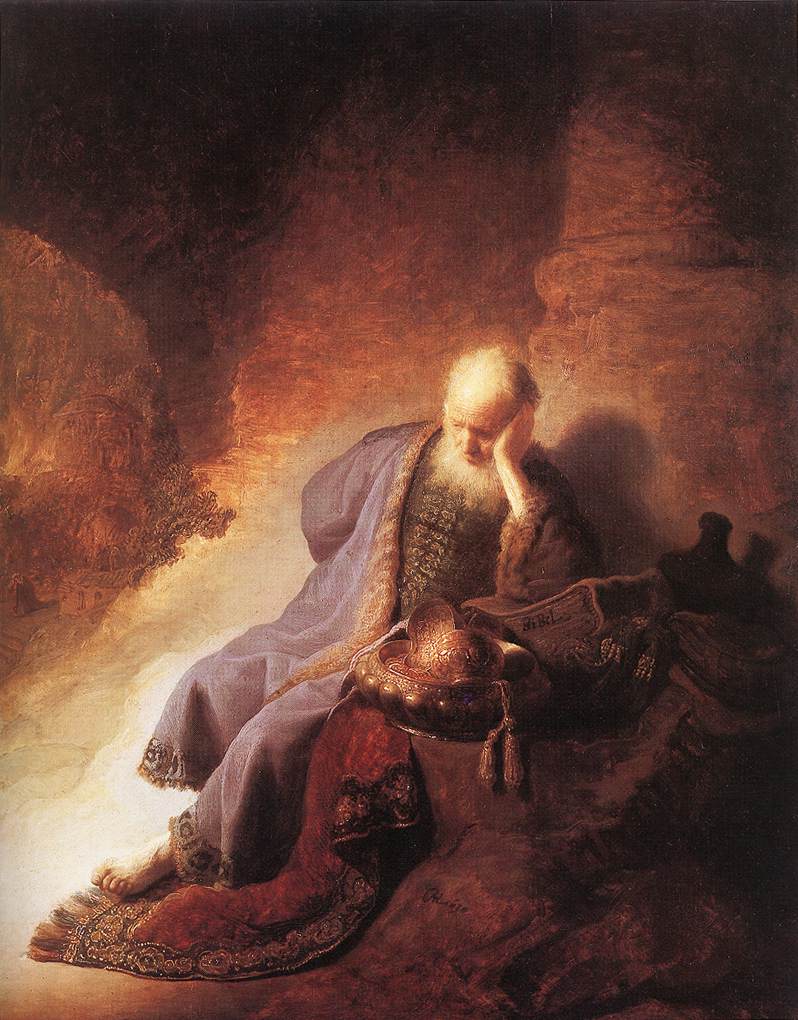
Rembrandt's Jeremiah
The third instalment of The Bible series on TV was on last night. It was just a single episode (#5) and covered the fall of Jerusalem and a few stories from the life of Daniel. This time, I am happy to say, I agreed with the filmmakers' interpretation.

I liked the way that they had a relatively unknown Bible character (Zedekiah) and how they had Jeremiah in the story as well. Although he does not appear in the Book of Kings, we see from the Book of Jeremiah that he was an important figure in the last days of Jerusalem.

They included the story of Daniel interpreting Nebuchadnezzar's dream (Daniel 2), Shadrach, Meshach and Abednego in the fiery furnace (Daniel 3), and Daniel in the lions' den (Daniel 6). I was disappointed with Nebuchadnezzar's response to Daniel's interpretation of his dream. He says something like "You're a brave man, I value that; you will serve me." In the Bible, however, it says that he "fell upon his face and paid homage to Daniel, and commanded that an offering and incense be offered up to him" (Daniel 2:46).

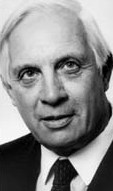
Donald Wiseman (1918 – 2010)
When we come to the story of Daniel in the lions' den, the TV series has Cyrus as the king, instead of Darius. This website lists this as one of the inaccuracies of the series, but in fact they are – correctly in my opinion – identifying Darius and Cyrus. This is following a suggestion first offered by Donald Wiseman in 1957, and it comes from a particular interpretation of Daniel 6:28. The Hebrew word usually translated "and" can also mean "namely" or "that is" – "So this Daniel prospered during the reign of Darius – that is, the reign of Cyrus the Persian." The identification of Darius and Cyrus indicates that Daniel had an important part to play in the return of the Jews to Palestine. It's great to see that this interpretation has now become somewhat mainstream.

I also appreciated how the episode was working hard to connect to the New Testament. It correctly construed Cyrus as a Messiah-figure (see Isaiah 45:1) and when he entered Babylon on a donkey, people throw palm fronds in his path, in subtle anticipating of Jesus entering Jerusalem on Palm Sunday. The episode emphasises Daniel 2:44, which surely is one of the most significant prophecies in the Old Testament. And the fourth beast of Daniel 7 is (correctly) interpreted as the Roman empire, which enables the series to jump forward into the New Testament era.

Finally, I was interested to note that the episode also borrowed from the "Prayer of Azariah", appearing in the Septuagint version of Daniel, and included in the Apocrypha. I guess that's better than just making up one's own dialogue in telling these stories.

Read my reviews of Part 1 and Part 2

Wednesday, July 24, 2013

The Bible, Part 2

My Presbytery meeting finished early last night, and I was home in time to watch the next instalment of The Bible, which consisted of episodes 3 and 4. The story covered Joshua, Rahab and Jericho, then skipped to Samson, and then skipped again to Samuel as an old man, when Israel asked him for a king. Saul was portrayed particularly well, I thought.

There is another gratuitous battle scene in Jericho – as if the Bible didn't have enough – but I suppose it helped to explain why the spies were known to be in Jericho. I was glad they had the scene with the Commander of the Armies of Yahweh, but the TV series portrays him as merely angelic, whereas the text hints that it is God himself, since the one thing he says to Joshua is "Take off your sandals from your feet, for the place where you are standing is holy."

One annoying thing about the series is that it adopts a late date for the Exodus (c. 1250 BC) which means that it is 150 years from Joshua to Saul – whereas 1 Kings 6:1 says that it was 480 years from the Exodus to Solomon. One consequence of adopting the late date is that the period of the judges needs to be squashed, and it must be concluded that the judges were ruling at the same time. This has the effect of making the judges local heroes – something the series is explicit about. But it goes against the emphasis in the text on the judges "judging Israel" and not just particular tribes or localities.

Samson killing the Philistines, by Gustav Doré
The other thing that annoyed me was the interpretation of the word eleph. This is traditionally translated "thousand" as in "Samson found a fresh jawbone of a donkey, and put out his hand and took it, and with it he struck 1,000 men" (Judges 15:15). But some scholars, who find the large numbers in the Bible hard to accept, suggest that "eleph" means a military unit – something like a dozen men. The TV show follows this, and has Samson killing a dozen men with the jawbone of a donkey. Not only does this make the feat so much less spectacular, but Samson himself talks about the "heaps" of men he has killed. The strongest argument, however, against the "military unit" idea is that it means Gideon is only reducing his army from 400 to 300, instead of from 32,000 to 300. For a helpful discussion on this issue, see Barry Webb's new commentary on Judges, pages 71-74.

As for the popularity of the series, the phenomenal ratings have died down a bit – last night's episode had only 600,000 viewers. Or is that meant to be 600 × 12 = 7200?

Read my review of Part 1

Wednesday, July 17, 2013

So much is missing, but better than expected

Last night I watched the TV miniseries The Bible on channel Nine. This was a double episode, out of a series of ten.

Naturally, a series like this has to skip lots of stories. It starts with Noah, skips the Tower of Babel, focuses extensively on Abraham, skips Jacob and Joseph, and then focuses on Moses. Within the story of Abraham, it skips the wife-sister narratives, and focuses on the battle of Genesis 14, the destruction of Sodom, and the testing of Abraham in Genesis 22.

It raises the question, are we allowed to "fill in the gaps" – in imagination, teaching, or, in this case, on screen – when the Bible is silent? For example, I thought Lot's wife was really well portrayed. The Bible tells us almost nothing about her, and she does not speak at all, but from what we do know about her, (and how she is turned into a pillar of salt), we can build up an impression. Her portrayal in this series (with lines like "The future is in the city") was extremely plausible.

I thought the episode had a good introduction. It starts with Noah in the ark. What were the people doing all that time? The Bible doesn't say. The TV series has Noah telling the story of creation to his family. I see that this aspect has been criticised on the basis that the the creation account was not written until much later. However, I think it very likely that there was a strong oral tradition (particularly along the covenant line) of the creation story being passed down.

It is important to point out that this series is not particularly Christian. There is very little here with which a non-Christian Jew, for example, would disagree. There was, for example, no reference to the protoevangelium – the promise of the Messiah given in Genesis 3. However, when the three figures appear to Abraham, the scene is done very well – two show their faces, while one stays hidden. The hidden one would be the one who, according to the biblical text, is the LORD himself.

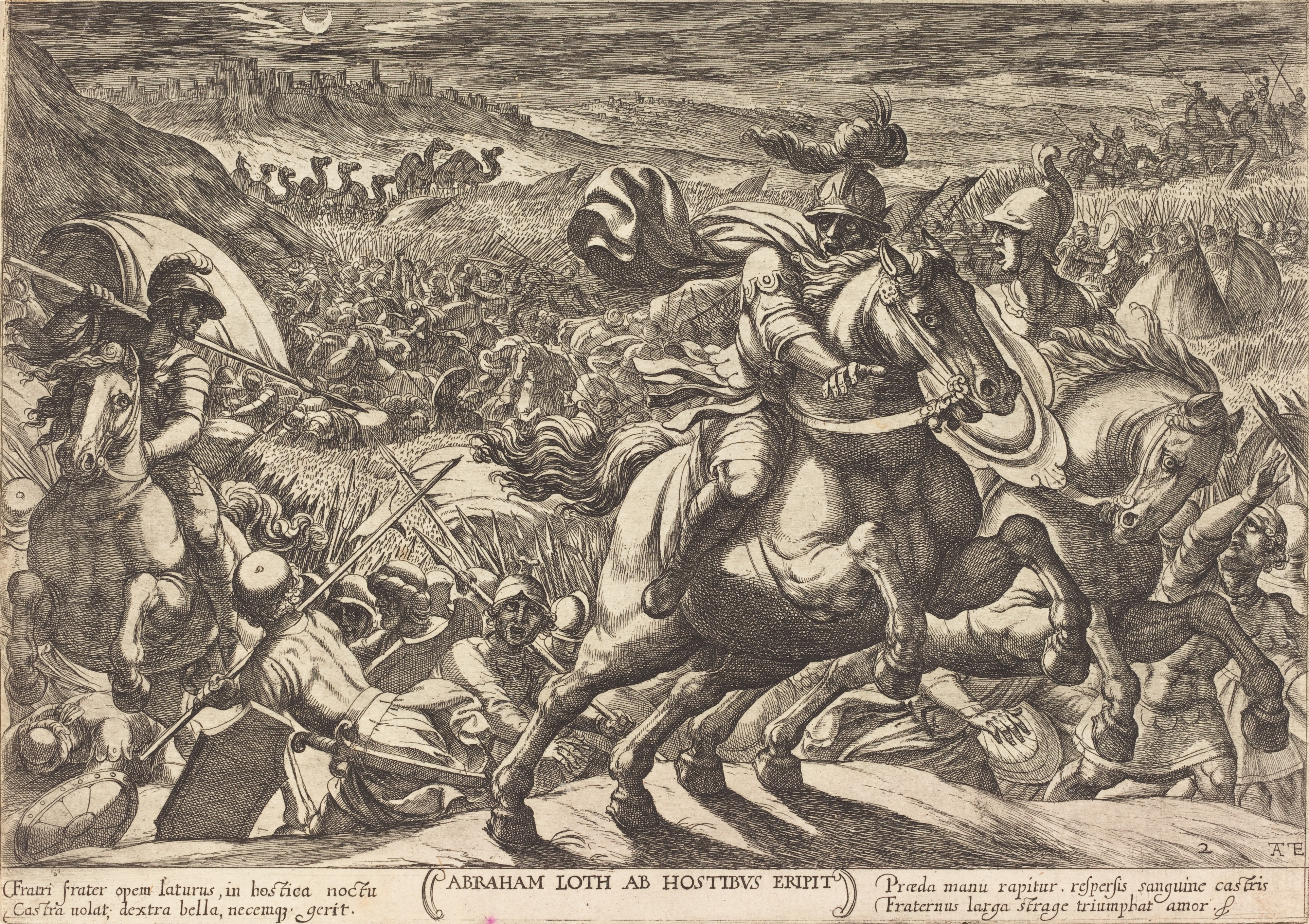
Tempesta's depiction of the battle is more faithful to the text.
I found the Battle of Siddim disappointing. According to the Bible, Abraham has an army of 318 men, and seems to fight a pitched battle. In this series, it's a stealth attack with a mere handful of men. (Was this due to a low budget?) The mysterious but important figure of Melchizedek is dropped altogether. And there is nothing here about about Abraham winning a battle on behalf of the kings of the land (even the king of Sodom!) In fact, the promise of Abraham being a blessing is missing, though offspring and land are emphasised. So "I will make you a father of many nations" becomes "I will make you a father of God's nation". If I can put it like this, the series is too Jewish. It doesn't have the universal scope of the promises that the biblical text exhibits.

The story of Sodom is toned down a bit, kind of the way you might tell it to children. But it means we have Sodom without the sodomy. There is no hint of homosexual rape, and Lot doesn't offer his daughters to the mob. (The daughters look very young anyway.)  The series has been criticised for its ninja angels, and although I like the idea of depicting angels as warriors, I would have though the Bible had enough action without needing to introduce more.

The depiction of Abraham's faith is rather disappointing. When God speaks to him, it is inaudible (unlike with Moses and the burning bush) and as a result Abraham seems somewhat mad. When Abraham is tested in the TV series, he says to Isaac, "The Lord will provide a sacrifice, my son." That is a significant departure from the biblical text of Genesis 22, which has "a lamb for the sacrifice". This change makes the viewer think that Abraham doesn't really believe God will rescue Isaac.

Of course, we need the New Testament to fully understand this story. Hebrews 11 says that Abraham "considered that God was able even to raise him from the dead, from which, figuratively speaking, he did receive him back." B. B. Warfield says that the Old Testament is like a richly furnished but dimly lit room – we need the light of the New Testament to illuminate it.

In this picture Pharaoh is drowned, but the Bible doesn't say that.
Even I learned something knew while watching it. I have to admit that it only occurred to me while watching the show that the (non-)sacrifice of Isaac in Genesis is a prefigurement of the Death of the Firstborn in Exodus. And I was surprised to see that, in the series, Pharaoh survived the crossing of the Red Sea, only to discover that the Bible is not totally clear on this point. It says that "Pharaoh drew near" (Exodus 14:10) that God "will get glory over Pharaoh and all his host, his chariots, and his horsemen" (v. 17), that "the Egyptians pursued and went in after them into the midst of the sea, all Pharaoh's horses, his chariots, and his horsemen" (v. 23), and that "of all the host of Pharaoh that had followed them into the sea, not one of them remained" (v. 28). Similarly, Exodus 15:4 says "Pharaoh's chariots and his host he cast into the sea, and his chosen officers were sunk in the Red Sea." This does rather make it seem that Pharaoh sent his army into the sea rather than going in himself. Psalm 136:15 says God "overthrew Pharaoh and his host in the Red Sea", but that could refer to the military defeat rather than actual drowning.

This post obviously doesn't exhaust the possibilities of what can be said about this series. There are a few more inaccuracies that I haven't mentioned here. For a couple of other interesting blog posts on the series, see here and here.

Saturday, May 25, 2013

Exploding the myths about the Crusades

God's Battalions: The Case for the Crusades by Rodney Stark

Taking the subtitle into account, this is the most provocatively titled book I've read since Peter Leithart's Against Christianity.

Actually, Stark is just telling the story of the Crusades - and what a fascinating story it is. He is not justifying them, but explaining them, and exploding some of the myths behind them.

Stark's points include:
  • The Crusades did not occur in a vacuum, but were a response to centuries of Muslim conquest and violence.
  • The Crusades were not driven by greed, but were recognized from the very beginning to be an excessively expensive exercise.
  • The crusaders were not more violent or barbaric than the Muslims.
  • The Muslim world has not held a 900-year grudge concerning the Crusades - Muslim antagonism about the Crusades did not appear until about 1900.
One example of the way the Crusades have been dealt with by historians concerns the Fall of Antioch in 1268, when a Muslim army took back Antioch, and slaughtered tens of thousands of its residents. Stark notes that whereas Christopher Tyerman (in his 2006 book God's War: A New History of the Crusades) devotes several pages to the massacre of Jerusalem during the First Crusade, he dismisses the massacre of Antioch in four words. Most histories of the Crusades, it would seem, have a sharp anti-Western bias.

This is an eminently readable, gripping introduction to a fascinating period of history - and one which has enormous relevance for the present day.