Showing posts with label biblical studies. Show all posts

Friday, December 01, 2017

Helpful but with some dubious assertions

Jesus on Every Page: 10 Simple Ways to Seek and Find Christ in the Old Testament by David Murray

This book is an accessible summary of the way the Old Testament points to Jesus. Murray notes that there are many connections to draw to Jesus, and attempts to provide a reasonably complete survey of these connections.

Murray is basically correct in his approach. He sees Jesus on every page, though not necessarily, it seems, in every verse. That is, every story can be connected to Jesus even if we have to be careful not to press the analogy in every detail. Murray makes a lot of 1 Peter 1:12 (" It was revealed to them [the prophets] that they were serving not themselves but you, in the things that have now been reported to you") in arguing that the Old Testament prophets knew about the New Testament era that was coming. The Old Testament "things" is the same as the New Testament "reports".

Murray is spot on at many points. For example, he correctly points out, on the basis of Acts 2:30-31, that in Psalm 16 David was a "believing Christian speaking of Christ as his only hope" (p. 194). I also appreciate Murray's alliteration in arranging his subpoints: his chapter on Jesus and Creation has the headings "The Arrangement of Redemption," "The Arena of Redemption," "The Aim of Redemption," "The Accessories of Redemption," "The Assistants of Redemption," "The Advance of Redemption," "The Analogy of Redemption," "The Advantages of Redemption," "The Apex of Redemption," "The Author of Redemption," and "The Application of Redemption".

There are, however, numerous points at which I disagree with Murray, either because he makes a dubious assertion or because he omits a critical point. I will restrict myself to three examples.

Firstly, Murray tends to see Jesus as doing everything in the Old Testament. For example, he argues that "the Son of God is the usual way God appears to humanity" (p. 76). Yet this has the effect of diminishing the work of the Holy Spirit. If we are going to apportion divine deeds among the different members of the Trinity (and that in itself is fraught with peril), then many Old Testament acts must be seen as the work of the Spirit (e.g. Nehemiah 9:20).

Secondly, in looking at Jesus in the prophetic books, Murray omits the idea that Jesus is the one on whom the judgement falls. He talks about Jesus being the judge of the nations (p. 128) but we can also look at judgement the other way: when Nahum 1:2 says "The Lord is a jealous and avenging God; the Lord is avenging and wrathful", we have to remember that this wrath against sin fell on Jesus. This is a glaring omission in what attempts to be a complete catalogue of connections between the Old and New Testaments.

Thirdly, in talking about covenant signs, Murray claims that "the crown on David's head reminded him and all Israel of God's promise of an everlasting king and kingdom" (p. 167). There is, however, no reference to David being crowned until he obtains the crown of the King of Rabbah in 2 Samuel 12:30. David was anointed with oil (2 Samuel 2:4) but the crown is not itself a Davidic symbol. It is used in the Psalms (89:39 and 132:18) to refer to the later monarchy, and perhaps this is where Murray gets the idea.

Thus, Jesus on Every Page is a rather annoying book. It is helpful in many ways, but it could have been so much better. The numerous points of disagreement I had prevent me from recommending it wholeheartedly.

Tuesday, October 11, 2016

Not your grandmother's theonomy

The Bounds of Love: An Introduction to God's Law of Liberty by Joel McDurmon

Although it's not really clear from the title, this book is about theonomy, which McDurmon defines as "the biblical teaching that Mosaic Law contains perpetual moral standards for living, including some civil laws, which remain obligatory for today" (p. 17).

The key phrase here is "including some civil laws". This is a reasonable definition: non-theonomic Reformed people would say that no civil laws remain obligatory for today (only, perhaps, the principles behind the laws). But in his discussion of which civil laws remain obligatory, McDurmon departs in a significant way from older Theonomic writers such as Rousas Rushdoony, Greg Bahnsen, and Gary North.

In chapter 3, McDurmon argues that crimes relating to worship (e.g. idolatry and blasphemy) and sex (e.g. homosexuality and adultery) carried the death penalty in the Old Testament because of the concept of herem, in which things that could contaminate Israel needed to be destroyed. McDurmon argues that this no longer applies today. Although he isn't clear on this point, he seems to suggest that they should not even be crimes today (though of course, they are still sins). Later in the book he says that in a "properly theonomic society", the government "would have little to do with sex or marriage" (p. 94).

In chapter 4, McDurmon argues that all other Old Testament death penalties (e.g. for rape and kidnapping) still apply, on the basis that the penalties were an expression of God's perfect justice. Yet this does not sit easily with what was stated in the previous chapter: the death penalty for blasphemy was also a just one, yet McDurmon says it no longer applies. In any case, McDurmon's position represents a significant (and very conscious) departure from traditional theonomy.

Finally, with regards to practical application, McDurmon correctly notes that the Great Commission includes a command to disciple the nations, and teach God's law to entire societies rather than just individuals (p. 104). Yet it seems he has a defective view of discipleship. Discipleship, among other things, encourages inner conviction rather than just behaviour modification. That also applies in "teaching the nations". So when McDurmon says  that Christians "should always lead opposition to any and all taxation" (p. 112), one can't help but feel that he has misplaced priorities and is fighting the wrong battles.

The Bounds of Love is an interesting read but not really a book I would recommend.

Sunday, May 08, 2016

Some good points, but based on an unconvincing hermeneutic

Corporal Punishment in the Bible: A Redemptive-Movement Hermeneutic for Troubling Texts by William J. Webb

This is a book arguing against smacking (spanking) children. Webb particularly interacts with organisations such as Focus on the Family, which advocates smacking, but suggests a parent administer no more than two smacks at a time. Webb argues that such an approach is not "biblical" at all, in the sense that it has moved beyond what he calls the Bible's "concrete specific instructions". Webb points out that the Book of Proverbs encourages using a rod on the back, rather than a hand on the bottom. Webb than says that the way Focus on the Family has moved beyond the Bible is a good thing, and we should go even further, following the Bible's own trajectory towards a more gentle approach. Webb calls this a "redemptive-movement hermeneutic".

Firstly, the book has a rather condescending feel about it. Webb is constantly "commending" corporal punishment advocates for going beyond the Bible, when they would argue, of course, that they are faithfully following the principles laid out in Proverbs. Webb also notes that he used to believe in smacking, but now he knows better.

Secondly, Webb focuses his attention on a narrow band within the broad spectrum of Christian smacking advocates. He seems to have no knowledge, for example, of Michael Pearl, who does indeed argue for using a "rod". Maybe he knows about Pearl but considers him too fringe or discredited to be worth mentioning. In any case, different pastors, authors, and parents apply the biblical teaching on smacking in different ways (this article from Capitol Hill Baptist Church mentions a plastic spoon), and it's not clear that the Focus on the Family approach can be said to be representative. Webb struggles to articulate what could be wrong in using  an actual rod. The only arguments he gives are: (a) it gives him a feeling of revulsion, and (b) even Focus on the Family avoids it.

Thirdly, at the heart of everything he says about smacking is Webb's redemptive-movement hermeneutic. It's the idea that we look at how the Bible's approach to a certain issue is different to that of the surrounding culture. (In this case, ancient Egyptian and Babylonian laws.) To put it bluntly, we see how the Bible has improved upon that, we discern the direction that the Bible takes us, and go further in that direction. This sounds a lot like improving upon the Bible, and it is. Webb's hermeneutic fails to take into account that in Christ we already have God's fullest revelation. For more details, see Thomas Schreiner's review of Webb's earlier book, Slaves, Women & Homosexuals.

I was all set to give this book a two-star rating, but Webb includes a postscript in which he gives an excellent overview of "alternative" disciplinary methods. Regardless of whether one agrees with smacking or not, there is a lot of helpful parenting advice here. That was good enough to lift the book up to three stars.

Sunday, December 21, 2014

Some unusual terminology, but well worth the effort

An Old Testament Theology: An Exegetical, Canonical, and Thematic Approach by Bruce Waltke with Charles Yu

This review is unprecedented as far as this blog goes in that I am reviewing a book that I have not yet finished. In fact, I am only about half way through. It has been rather heavy going, but it is worth the effort, and I intend to finish it next year.

An Old Testament Theology is a comprehensive textbook on the Old Testament. Waltke goes through it book by book, though some sections of the Bible receive more coverage than others. Genesis gets 173 pages, Job gets 19, Song of Solomon gets nothing at all.

One of the interesting features of the this book is that each chapter is of the form "The Gift of...". This strikes me as a great organising principle for the Old Testament: "The Gift of the Cosmos", "The Gift of Liturgy", "The Gift of Kingship", etc.

The other thing that strikes the reader is the non-standard vocabulary employed. The hardest to get used to is the rendition of the covenant name of God as "I AM" throughout the book. Even more annoying is the use of "vice-regent" used several times. I think the word meant was "viceroy" (which has the associated adjective "viceregal") or else "vicegerent".

On the other hand, the best example of unusual terminology in the book is Waltke's use of "Sworn Land" instead of "Promised Land". Waltke notes that God doesn't just promise the land to Abraham, he swears an oath to him that he will give it. I wonder if the phrase will catch on.

In conclusion, this book will reward readers who put in the effort to carefully read, ponder, and evaluate what it says.

Monday, October 27, 2014

A soft complementarian position denying the eternal subordination of the Son

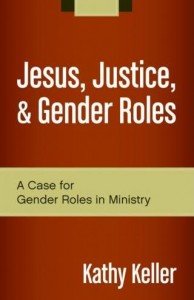
Jesus, Justice, & Gender Roles: A Case for Gender Roles in Ministry by Kathy Keller.

This is part of Zondervan's "Fresh Perspectives on Women in Ministry" series, the other volumes being John Dickson's Hearing Her Voice: A Case for Women Giving Sermons (see my review here) and Michael Bird's Bourgeois Babes, Bossy Wives, and Bobby Haircuts: A Case for Gender Equality in Ministry.

Kathy Keller is the wife of Tim Keller, pastor of Redeemer Presbyterian Church in New York City. The book is written in two parts. The first part ("Hermeneutical Imperatives") discusses relevant New Testament texts. Keller seems to be a soft complementarian. She translates 1 Timothy 2:12 as "I do not permit a woman to authoritatively teach a man", and believes that this still applies today. On the other hand, she is fine with women leading mixed Bible study groups. Following Redeemer's policy, she believes that women can do everything in the church that a non-ordained man can do. This does, however, presuppose a very high view of ordination. Although the emphasis in the pastoral epistles is certainly on the work of the pastor, especially preaching and teaching, Paul does not say "I do not permit a non-ordained person to authoritatively teach a man". In fact, just a few verses before, Paul had said that "the men should pray, lifting holy hands", and that the women "should adorn themselves in respectable apparel" (1 Tim. 2:8-9). Clearly, then, male/female roles and conduct are in mind, and not merely the ordained/non-ordained distinction.

In the second part of the book ("Personal Journeys"), Keller is apparently trying to reach out to disaffected women. She distances herself from anyone who is more complementarian than she (p. 33):
I am frequently embarrassed by others who use the title "complementarian" but who go beyond Scripture to legislate arbitrary rules about the age of boys when women must not teach Sunday school to them any longer, or whether a female small group leader should have a male co-leader if the group is mixed, and so on.

More disturbing, however, are Keller's views about the eternal subordination of the Son (p. 47). She says, "Jesus' submission to the Father was limited to his earthly incarnation" and "to my knowledge, no complementarian has ever espoused such a thing, despite egalitarian charges to the contrary". Well, Keller's knowledge is rather limited, because a host of complementarians have demonstrated that this is the historic Christian doctrine. See, for example, Biblical Evidence for the Eternal Submission of the Son to the Father by Wayne Grudem, The Eternal Subordination of the Son Is the Historic Doctrine of the Church by Dave Miller, and A Defense of the Doctrine of the Eternal Subordination of the Son by Stephen Kovach and Peter Schemm.

I'm afraid I couldn't help thinking that Keller was selected to write this book because Zondervan wanted the complementarian case to be presented by a woman. It would, however, have been better to ask someone more qualified to write this volume.

Wednesday, October 22, 2014

A revolution based on what a verse doesn't say

Hearing Her Voice: A Biblical Invitation for Women to Preach by John Dickson

This book is all about one verse in the New Testament: 1 Timothy 2:12, "I do not permit a woman to teach or to have authority over a man; she must be silent." Dickson argues that the verse does not forbid women from giving sermons today. His argument is as follows (pp. 80-81): There are many different different forms of public speaking in the New Testament, such as "exhorting", "preaching", and "teaching". Only one of them is forbidden to women – "teaching", in 1 Tim. 2:12. According to Dickson, this actually refers to "preserving and laying down the traditions handed on by the apostles", and this is not what happens in most modern-day sermons. Hence, women are allowed to give sermons today.

This is a rather idiosyncratic, and certainly very narrow definition of "teaching", and Dickson is not convincing. But even if we were to grant his definition, he is still on very flimsy ground.

Dickson fails to demonstrate why women are allowed to "exhort". The New Testament seems to use that word in two different ways: both personal encouragement, and delivering a "word of exhortation". The latter is used in Hebrews 13:22, in reference to the entire book, and Hebrews does seem to be a sermon, or at least composed of sermonic material. Why can women give this sort of exhortation? Dickson seems to suggest that because that particular word is not used as a prohibited activity for women, it is allowed. In this way, Dickson stands firmly in the Anglican tradition of the normative principle of worship, holding that whatever is not forbidden is allowed, but as an adherent of the regulative principle, I must reject this. The onus is on Dickson to demonstrate that women are allowed to preach; the fact that they are "not forbidden" is not good enough.

Again, even if we accept Dickson's definition of teaching, it is much better to see it applying today as "telling people what the Bible says". In fact, there is another possible definition, which Dickson completely ignores: "teaching" is what teachers do. And the New Testament says a lot about "teachers". Unfortunately, Dickson fails to mention Ephesians 4:11 ("He gave some to be apostles, and some to be prophets, and some to be evangelists, and some to be pastors and teachers"). Actually, he does allude to it on p. 78, and seems to suggest that the office of teacher has ceased. But this verse is talking about the pastor/teacher as a single office, and this office is restricted to men (1 Tim. 3:1-2). This is the office that Timothy held, and he was told to devote himself to "the public reading of Scripture, to exhortation, to teaching" (1 Tim. 4:13). This is describing the work that a (male) pastor does, and there is no indication in the New Testament that other people do this as well. Thus, there are good reasons why we would conclude from the New Testament that women are not allowed to "exhort", even if we grant Dickson's idea that modern-day sermons are essentially "exhortations" based on the text.

In short, Dickson is presenting an argument from silence. The book has a very feminist-sounding title, and my edition has quite an outrageous subtitle: "A Biblical Invitation for Women to Preach". (Other editions have "A Case for Women Giving Sermons"). Well, it's not a biblical invitation at all. It is based entirely on what Dickson argues one verse is not saying. We should not base doctrines on what single verses say, let alone on what they don't say.

Wednesday, July 31, 2013

The Bible, Part 3

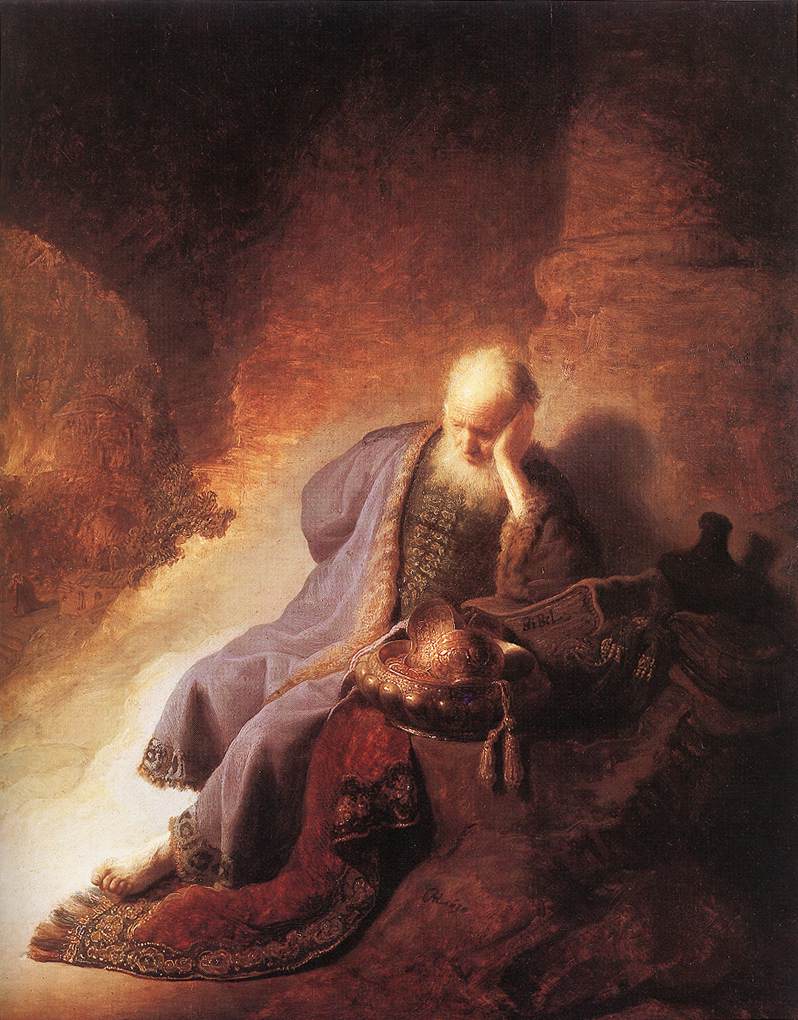
Rembrandt's Jeremiah
The third instalment of The Bible series on TV was on last night. It was just a single episode (#5) and covered the fall of Jerusalem and a few stories from the life of Daniel. This time, I am happy to say, I agreed with the filmmakers' interpretation.

I liked the way that they had a relatively unknown Bible character (Zedekiah) and how they had Jeremiah in the story as well. Although he does not appear in the Book of Kings, we see from the Book of Jeremiah that he was an important figure in the last days of Jerusalem.

They included the story of Daniel interpreting Nebuchadnezzar's dream (Daniel 2), Shadrach, Meshach and Abednego in the fiery furnace (Daniel 3), and Daniel in the lions' den (Daniel 6). I was disappointed with Nebuchadnezzar's response to Daniel's interpretation of his dream. He says something like "You're a brave man, I value that; you will serve me." In the Bible, however, it says that he "fell upon his face and paid homage to Daniel, and commanded that an offering and incense be offered up to him" (Daniel 2:46).

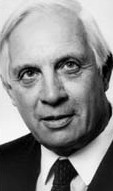
Donald Wiseman (1918 – 2010)
When we come to the story of Daniel in the lions' den, the TV series has Cyrus as the king, instead of Darius. This website lists this as one of the inaccuracies of the series, but in fact they are – correctly in my opinion – identifying Darius and Cyrus. This is following a suggestion first offered by Donald Wiseman in 1957, and it comes from a particular interpretation of Daniel 6:28. The Hebrew word usually translated "and" can also mean "namely" or "that is" – "So this Daniel prospered during the reign of Darius – that is, the reign of Cyrus the Persian." The identification of Darius and Cyrus indicates that Daniel had an important part to play in the return of the Jews to Palestine. It's great to see that this interpretation has now become somewhat mainstream.

I also appreciated how the episode was working hard to connect to the New Testament. It correctly construed Cyrus as a Messiah-figure (see Isaiah 45:1) and when he entered Babylon on a donkey, people throw palm fronds in his path, in subtle anticipating of Jesus entering Jerusalem on Palm Sunday. The episode emphasises Daniel 2:44, which surely is one of the most significant prophecies in the Old Testament. And the fourth beast of Daniel 7 is (correctly) interpreted as the Roman empire, which enables the series to jump forward into the New Testament era.

Finally, I was interested to note that the episode also borrowed from the "Prayer of Azariah", appearing in the Septuagint version of Daniel, and included in the Apocrypha. I guess that's better than just making up one's own dialogue in telling these stories.

Read my reviews of Part 1 and Part 2

Wednesday, July 24, 2013

The Bible, Part 2

My Presbytery meeting finished early last night, and I was home in time to watch the next instalment of The Bible, which consisted of episodes 3 and 4. The story covered Joshua, Rahab and Jericho, then skipped to Samson, and then skipped again to Samuel as an old man, when Israel asked him for a king. Saul was portrayed particularly well, I thought.

There is another gratuitous battle scene in Jericho – as if the Bible didn't have enough – but I suppose it helped to explain why the spies were known to be in Jericho. I was glad they had the scene with the Commander of the Armies of Yahweh, but the TV series portrays him as merely angelic, whereas the text hints that it is God himself, since the one thing he says to Joshua is "Take off your sandals from your feet, for the place where you are standing is holy."

One annoying thing about the series is that it adopts a late date for the Exodus (c. 1250 BC) which means that it is 150 years from Joshua to Saul – whereas 1 Kings 6:1 says that it was 480 years from the Exodus to Solomon. One consequence of adopting the late date is that the period of the judges needs to be squashed, and it must be concluded that the judges were ruling at the same time. This has the effect of making the judges local heroes – something the series is explicit about. But it goes against the emphasis in the text on the judges "judging Israel" – and not just particular tribes or localities.

Samson killing the Philistines, by Gustav Doré
The other thing that annoyed me was the interpretation of the word eleph. This is traditionally translated "thousand" as in "Samson found a fresh jawbone of a donkey, and put out his hand and took it, and with it he struck 1,000 men" (Judges 15:15). But some scholars, who find the large numbers in the Bible hard to accept, suggest that "eleph" means a military unit – something like a dozen men. The TV show follows this, and has Samson killing a dozen men with the jawbone of a donkey. Not only does this make the feat so much less spectacular, but Samson himself talks about the "heaps" of men he has killed. The strongest argument, however, against the "military unit" idea is that it means Gideon is only reducing his army from 400 to 300, instead of from 32,000 to 300. For a helpful discussion on this issue, see Barry Webb's new commentary on Judges, pages 71-74.

As for the popularity of the series, the phenomenal ratings have died down a bit – last night's episode had only 600,000 viewers. Or is that meant to be 600 × 12 = 7200?

Read my review of Part 1

Wednesday, July 17, 2013

So much is missing, but better than expected

Last night I watched the TV miniseries The Bible on channel Nine. This was a double episode, out of a series of ten.

Naturally, a series like this has to skip lots of stories. It starts with Noah, skips the Tower of Babel, focuses extensively on Abraham, skips Jacob and Joseph, and then focuses on Moses. Within the story of Abraham, it skips the wife-sister narratives, and focuses on the battle of Genesis 14, the destruction of Sodom, and the testing of Abraham in Genesis 22.

It raises the question, are we allowed to "fill in the gaps" – in imagination, teaching, or, in this case, on screen – when the Bible is silent? For example, I thought Lot's wife was really well portrayed. The Bible tells us almost nothing about her, and she does not speak at all, but from what we do know about her, (and how she is turned into a pillar of salt), we can build up an impression. Her portrayal in this series (with lines like "The future is in the city") was extremely plausible.

I thought the episode had a good introduction. It starts with Noah in the ark. What were the people doing all that time? The Bible doesn't say. The TV series has Noah telling the story of creation to his family. I see that this aspect has been criticised on the basis that the the creation account was not written until much later. However, I think it very likely that there was a strong oral tradition (particularly along the covenant line) of the creation story being passed down.

It is important to point out that this series is not particularly Christian. There is very little here with which a non-Christian Jew, for example, would disagree. There was, for example, no reference to the protoevangelium – the promise of the Messiah given in Genesis 3. However, when the three figures appear to Abraham, the scene is done very well – two show their faces, while one stays hidden. The hidden one would be the one who, according to the biblical text, is the LORD himself.

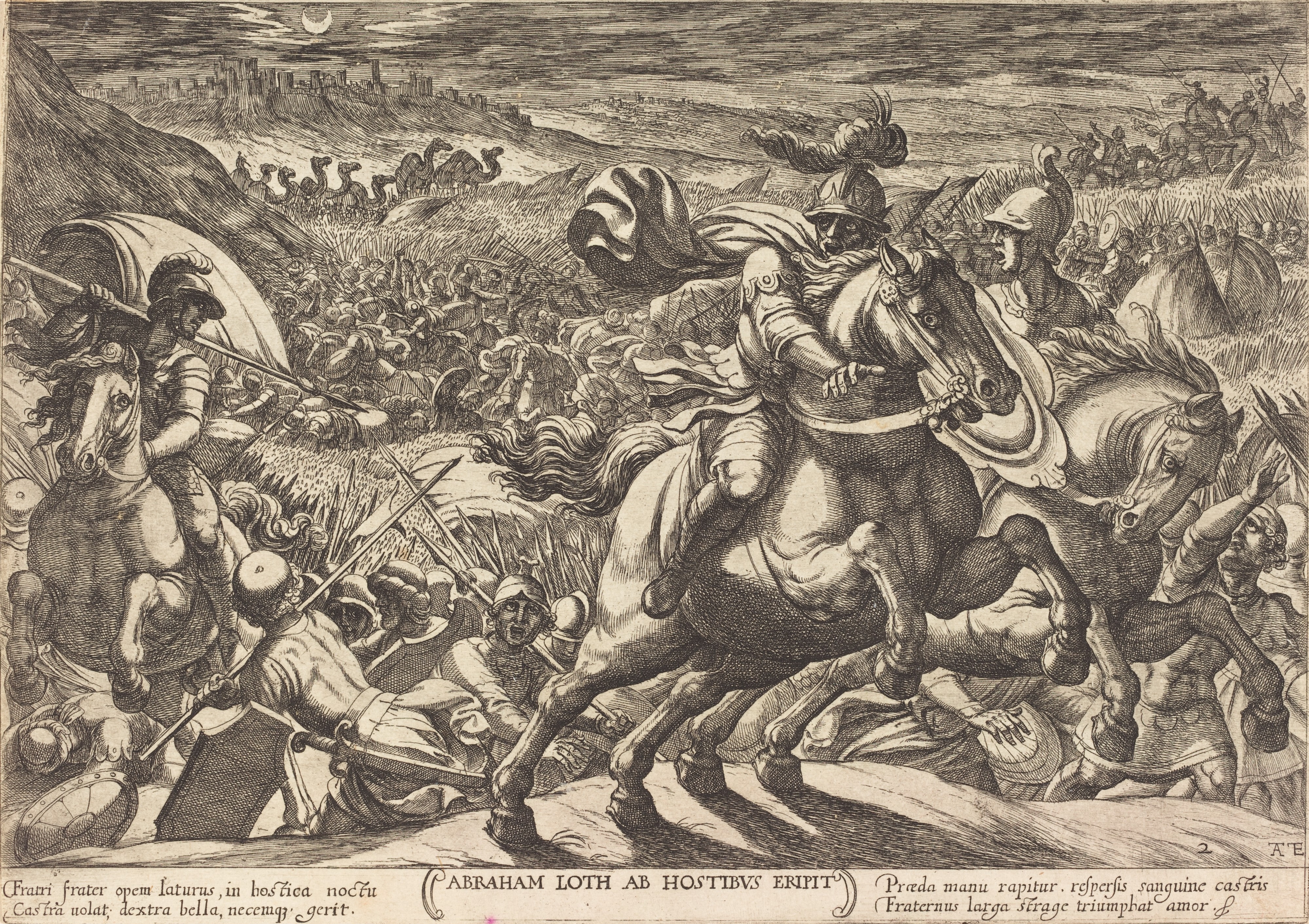
Tempesta's depiction of the battle is more faithful to the text.
I found the Battle of Siddim disappointing. According to the Bible, Abraham has an army of 318 men, and seems to fight a pitched battle. In this series, it's a stealth attack with a mere handful of men. (Was this due to a low budget?) The mysterious but important figure of Melchizedek is dropped altogether. And there is nothing here about about Abraham winning a battle on behalf of the kings of the land (even the king of Sodom!) In fact, the promise of Abraham being a blessing is missing, though offspring and land are emphasised. So "I will make you a father of many nations" becomes "I will make you a father of God's nation". If I can put it like this, the series is too Jewish. It doesn't have the universal scope of the promises that the biblical text exhibits.

The story of Sodom is toned down a bit, kind of the way you might tell it to children. But it means we have Sodom without the sodomy. There is no hint of homosexual rape, and Lot doesn't offer his daughters to the mob. (The daughters look very young anyway.)  The series has been criticised for its ninja angels, and although I like the idea of depicting angels as warriors, I would have though the Bible had enough action without needing to introduce more.

The depiction of Abraham's faith is rather disappointing. When God speaks to him, it is inaudible (unlike with Moses and the burning bush) and as a result Abraham seems somewhat mad. When Abraham is tested in the TV series, he says to Isaac, "The Lord will provide a sacrifice, my son." That is a significant departure from the biblical text of Genesis 22, which has "a lamb for the sacrifice". This change makes the viewer think that Abraham doesn't really believe God will rescue Isaac.

Of course, we need the New Testament to fully understand this story. Hebrews 11 says that Abraham "considered that God was able even to raise him from the dead, from which, figuratively speaking, he did receive him back." B. B. Warfield says that the Old Testament is like a richly furnished but dimly lit room – we need the light of the New Testament to illuminate it.

In this picture Pharaoh is drowned, but the Bible doesn't say that.
Even I learned something knew while watching it. I have to admit that it only occurred to me while watching the show that the (non-)sacrifice of Isaac in Genesis is a prefigurement of the Death of the Firstborn in Exodus. And I was surprised to see that, in the series, Pharaoh survived the crossing of the Red Sea, only to discover that the Bible is not totally clear on this point. It says that "Pharaoh drew near" (Exodus 14:10) that God "will get glory over Pharaoh and all his host, his chariots, and his horsemen" (v. 17), that "the Egyptians pursued and went in after them into the midst of the sea, all Pharaoh's horses, his chariots, and his horsemen" (v. 23), and that "of all the host of Pharaoh that had followed them into the sea, not one of them remained" (v. 28). Similarly, Exodus 15:4 says "Pharaoh's chariots and his host he cast into the sea, and his chosen officers were sunk in the Red Sea." This does rather make it seem that Pharaoh sent his army into the sea rather than going in himself. Psalm 136:15 says God "overthrew Pharaoh and his host in the Red Sea", but that could refer to the military defeat rather than actual drowning.

This post obviously doesn't exhaust the possibilities of what can be said about this series. There are a few more inaccuracies that I haven't mentioned here. For a couple of other interesting blog posts on the series, see here and here.

Friday, May 24, 2013

A published author

Dante's Vision of Rachel and Leah
I'm excited to announce that John has just had an article published by Tyndale Bulletin! It's called 'May the Lord Make the Woman like Rachel': Comparing Michal and Rachel. Tyndale Bulletin happens to be one of Galilee's favourite reads--at least, she's always taking our old copies from the shelf! Once the new issue arrives, I can tell her "your daddy wrote this".

Here's the abstract:
"The portrayal of Michal in the book of Samuel is similar to that of Rachel in the book of Genesis. Both have an older sister who is their rival for the affections of their husband. Both have an erratic father who pursues their husband. Both possess household idols called teraphim, which feature in the story of their deceiving their father. Both have at least a period of barrenness. Yet there are also differences between the two women, which can be explained in terms of the portrayal of Michal as an even more tragic figure than Rachel. Careful consideration of the points of similarity and difference yields the conclusion that the allusions to the Rachel story in the book of Samuel are intentional."

The whole article can be read here.

Sunday, May 22, 2011

A good taste of Wright's writing

The Challenge of Easter by N. T. Wright

This book is excerpted from Wright's
The Challenge of Jesus. I read it during Easter week, and found it quite thought-provoking. It is, in fact, a very good introduction to Wright's writing.

Firstly, Wright's theme of the Kingdom of God comes out in this book. Wright sees New Testament Christianity as being "Jewish no-king-but God theology - with Jesus in the middle" (p. 12). He emphasises how the Jewish concept of the Kingdom of God concerned public events ("The end of Israel's exile, the overthrow of the pagan empire and the exaltation of Israel, and the return of YHWH to Zion to judge and save") and is thus much more than a new spiritual experience or sense of forgiveness.

Secondly, we see here Wright as an apologist for the physical resurrection of Jesus. He takes issue with Barbara Thiering (who says that Jesus was crucified, but did not die on the cross, p. 8) and Dominic Crossan (who does not believe that Jesus was buried, p. 22). This sort of defence is greatly expanded in Wright's The Resurrection of the Son of God.

Thirdly, Wright draws some fascinating parallels between the gospel accounts and the creation narratives in Genesis. He notes that Jesus was crucified on the sixth day of the week, which corresponds to God's completion of creation (p. 33) and he was rose on the first day of the week, which inaugurates a new creation. He then says, "Mary goes to the tomb while it's still dark and in the morning light she meets Jesus in the garden. She thinks he is the gardener, and in one important sense he indeed is" (p. 34.)

Fourthly, this book contains an example of all that for which Wright gets criticised - puzzling statements of dubious orthodoxy. He says on p. 59 that
Jesus did not know he was God, if by "know" we meant what the Enlightenment meant. Now, this statement is incomprehensible to me, but whatever Wright means by this, it would seem that a lot of people will be left confused as to what he is saying.

So perhaps this book has the best and worst of Wright. But like C. S. Lewis, I often find doctrinal books more helpful in devotion than the devotional books, and this was a useful book to read in Eastertide.

John Dekker

Wednesday, April 20, 2011

My favourite commentary on Daniel

The Handwriting on the Wall: A Commentary on the Book of Daniel by James B. Jordan

I have been teaching on the Book of Daniel at PTC this semester, and this book has been very helpful in my preparation and study.

I first started reading Jordan about ten years ago. His biblical studies are always stimulating, often novel, sometimes rather weird. His Biblical Horizons newsletter is online, and I particularly recommend "Eldership and Maturity" (Parts 1 and 2) and "Concerning Colors, Architecture, and Sacraments."

In this commentary on Daniel, the most important thing is that Jordan takes the text seriously. This naturally leads him to take an early date for the book, and means that he has to part ways with the majority of scholars on various points of interpretation.

The most unusual contribution he makes to the study of the book is seeing King Herod at different points. This starts in the vision of the statue in chapter 2. The legs of the statue are iron, while the feet are iron and clay. The iron is traditionally taken to be Rome, which Jordan accepts, but whereas the iron + clay is usually interpreted as the declining Roman empire, Jordan takes it to be the mixture of Romans and Jews who sought to join Rome (p. 182), exemplified in Herod. That is, the iron and clay mixture is the one ruling Palestine in the first century, and so this explanation makes the best sense of Daniel 2:44, "In the time of those kings, the God of heaven will set up a kingdom that will never be destroyed."

Jordan tends to see Herod everywhere in the Book of Daniel - the little horn in chapter 7, the horn in chapter 8 and the king in Daniel 11:36-45. I disagree with the first two identifications, but at this point in time I agree with Jordan's interpretation of Daniel 11.

The book contains some interesting appendices, one comparing Joseph and Daniel, and another (based on this article) suggesting that the words Jesus wrote in John 8:6 are the words mene, mene, tekel, parsin from Daniel 5:25.

The Handwriting on the Wall is my favourite commentary on the book of Daniel.

John Dekker.

Sunday, February 06, 2011

Creation Revealed in Six Days

I plan to blog in a new way this year. Instead of just listing the books I am reading monthly, I plan to post some proper book reviews, hopefully weekly.

Creation Revealed in Six Days by P. J. Wiseman

This book contains a little-known proposal on how to reconcile the narrative of Genesis 1 with geological evidence that suggests that the earth is millions of years old. There have been several different attempts at reconciliation - the Young Earth theory says that the universe was created in 144 hours and that geological dating which suggests otherwise is erroneous; the Day-Age theory suggests that the days of Genesis 1 are much longer periods of time, such as geological ages ; while the Gap Theory posits a long time between Genesis 1:1 ("In the beginning God created the heavens and the earth") and Genesis 1:2 ("And the earth was desolate and deserted"), so that the six (literal) days of creation occur when the earth is already very old. Gerald Schroeder has the ingenious theory that creation occurred in six days within the relativistic framework of the things being created, which equates to billions of years for an earth observer. Wiseman's theory is different to all of these - he argues that God revealed the story of creation to man in six literal days.

Wiseman's thesis argument rests on the hypothesis that the "generations" statements in Genesis refer to what come before rather than (as traditionally interpreted) headings for what come after. This is sometimes called the Wiseman hypothesis. Thus, Genesis 2:4 ("These are the generations of the heavens and the earth when they were created,in the day that the LORD God made the earth and the heavens") refers to the whole narrative from 1:1 to 2:3. Furthermore, Wiseman argues that generations means "written account" or "histories" and concludes that God's revelation of creation to man took six (literal) days.

This is an attractive theory precisely because it allows for a literal interpretation of the word "day", while at the same time accepting geological and other scientific evidence for an old earth. It is ultimately unconvincing in its argument about the word "generations" - how, for example, could Genesis 36:1 be referring to Genesis 35? Yet it does remind us that there are avenues of interpretation that we have hitherto overlooked, and ways of reconciling apparent contradictions that are still undiscovered.

The book is quite pleasant to read, although his arguments are not always clear. He does pay careful attention to the text, and that gives value to the book regardless of whether or not one agrees with his argument.

Wiseman was an Air Commodore in the Royal Air Force who became interested in biblical archaeology through his service in the Middle East. He was also the father of Donald Wiseman.

John Dekker