Corporal Punishment in the Bible: A Redemptive-Movement Hermeneutic for Troubling Texts by William J. Webb
This is a book arguing against smacking (spanking) children. Webb particularly interacts with organisations such as Focus on the Family, which advocates smacking, but suggests a parent administer no more than two smacks at a time. Webb argues that such an approach is not "biblical" at all, in the sense that it has moved beyond what he calls the Bible's "concrete specific instructions". Webb points out that the Book of Proverbs encourages using a rod on the back, rather than a hand on the bottom. Webb than says that the way Focus on the Family has moved beyond the Bible is a good thing, and we should go even further, following the Bible's own trajectory towards a more gentle approach. Webb calls this a "redemptive-movement hermeneutic".
Firstly, the book has a rather condescending feel about it. Webb is constantly "commending" corporal punishment advocates for going beyond the Bible, when they would argue, of course, that they are faithfully following the principles laid out in Proverbs. Webb also notes that he used to believe in smacking, but now he knows better.
Secondly, Webb focuses his attention on a narrow band within the broad spectrum of Christian smacking advocates. He seems to have no knowledge, for example, of Michael Pearl, who does indeed argue for using a "rod". Maybe he knows about Pearl but considers him too fringe or discredited to be worth mentioning. In any case, different pastors, authors, and parents apply the biblical teaching on smacking in different ways (this article from Capitol Hill Baptist Church mentions a plastic spoon), and it's not clear that the Focus on the Family approach can be said to be representative. Webb struggles to articulate what could be wrong in using an actual rod. The only arguments he gives are: (a) it gives him a feeling of revulsion, and (b) even Focus on the Family avoids it.
Thirdly, at the heart of everything he says about smacking is Webb's redemptive-movement hermeneutic. It's the idea that we look at how the Bible's approach to a certain issue is different to that of the surrounding culture. (In this case, ancient Egyptian and Babylonian laws.) To put it bluntly, we see how the Bible has improved upon that, we discern the direction that the Bible takes us, and go further in that direction. This sounds a lot like improving upon the Bible, and it is. Webb's hermeneutic fails to take into account that in Christ we already have God's fullest revelation. For more details, see Thomas Schreiner's review of Webb's earlier book, Slaves, Women & Homosexuals.
I was all set to give this book a two-star rating, but Webb includes a postscript in which he gives an excellent overview of "alternative" disciplinary methods. Regardless of whether one agrees with smacking or not, there is a lot of helpful parenting advice here. That was good enough to lift the book up to three stars.
Showing posts with label pastoral theology. Show all posts
Sunday, May 08, 2016
Monday, October 27, 2014
A soft complementarian position denying the eternal subordination of the Son
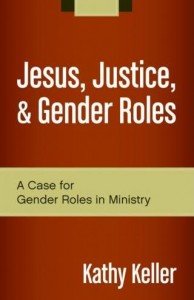
Jesus, Justice, & Gender Roles: A Case for Gender Roles in Ministry by Kathy Keller.
This is part of Zondervan's "Fresh Perspectives on Women in Ministry" series, the other volumes being John Dickson's Hearing Her Voice: A Case for Women Giving Sermons (see my review here) and Michael Bird's Bourgeois Babes, Bossy Wives, and Bobby Haircuts: A Case for Gender Equality in Ministry.
Kathy Keller is the wife of Tim Keller, pastor of Redeemer Presbyterian Church in New York City. The book is written in two parts. The first part ("Hermeneutical Imperatives") discusses relevant New Testament texts. Keller seems to be a soft complementarian. She translates 1 Timothy 2:12 as "I do not permit a woman to authoritatively teach a man", and believes that this still applies today. On the other hand, she is fine with women leading mixed Bible study groups. Following Redeemer's policy, she believes that women can do everything in the church that a non-ordained man can do. This does, however, presuppose a very high view of ordination. Although the emphasis in the pastoral epistles is certainly on the work of the pastor, especially preaching and teaching, Paul does not say "I do not permit a non-ordained person to authoritatively teach a man". In fact, just a few verses before, Paul had said that "the men should pray, lifting holy hands", and that the women "should adorn themselves in respectable apparel" (1 Tim. 2:8-9). Clearly, then, male/female roles and conduct are in mind, and not merely the ordained/non-ordained distinction.
In the second part of the book ("Personal Journeys"), Keller is apparently trying to reach out to disaffected women. She distances herself from anyone who is more complementarian than she (p. 33):
More disturbing, however, are Keller's views about the eternal subordination of the Son (p. 47). She says, "Jesus' submission to the Father was limited to his earthly incarnation" and "to my knowledge, no complementarian has ever espoused such a thing, despite egalitarian charges to the contrary". Well, Keller's knowledge is rather limited, because a host of complementarians have demonstrated that this is the historic Christian doctrine. See, for example, Biblical Evidence for the Eternal Submission of the Son to the Father by Wayne Grudem, The Eternal Subordination of the Son Is the Historic Doctrine of the Church by Dave Miller, and A Defense of the Doctrine of the Eternal Subordination of the Son by Stephen Kovach and Peter Schemm.
I'm afraid I couldn't help thinking that Keller was selected to write this book because Zondervan wanted the complementarian case to be presented by a woman. It would, however, have been better to ask someone more qualified to write this volume.
This is part of Zondervan's "Fresh Perspectives on Women in Ministry" series, the other volumes being John Dickson's Hearing Her Voice: A Case for Women Giving Sermons (see my review here) and Michael Bird's Bourgeois Babes, Bossy Wives, and Bobby Haircuts: A Case for Gender Equality in Ministry.
Kathy Keller is the wife of Tim Keller, pastor of Redeemer Presbyterian Church in New York City. The book is written in two parts. The first part ("Hermeneutical Imperatives") discusses relevant New Testament texts. Keller seems to be a soft complementarian. She translates 1 Timothy 2:12 as "I do not permit a woman to authoritatively teach a man", and believes that this still applies today. On the other hand, she is fine with women leading mixed Bible study groups. Following Redeemer's policy, she believes that women can do everything in the church that a non-ordained man can do. This does, however, presuppose a very high view of ordination. Although the emphasis in the pastoral epistles is certainly on the work of the pastor, especially preaching and teaching, Paul does not say "I do not permit a non-ordained person to authoritatively teach a man". In fact, just a few verses before, Paul had said that "the men should pray, lifting holy hands", and that the women "should adorn themselves in respectable apparel" (1 Tim. 2:8-9). Clearly, then, male/female roles and conduct are in mind, and not merely the ordained/non-ordained distinction.
In the second part of the book ("Personal Journeys"), Keller is apparently trying to reach out to disaffected women. She distances herself from anyone who is more complementarian than she (p. 33):
I am frequently embarrassed by others who use the title "complementarian" but who go beyond Scripture to legislate arbitrary rules about the age of boys when women must not teach Sunday school to them any longer, or whether a female small group leader should have a male co-leader if the group is mixed, and so on.
More disturbing, however, are Keller's views about the eternal subordination of the Son (p. 47). She says, "Jesus' submission to the Father was limited to his earthly incarnation" and "to my knowledge, no complementarian has ever espoused such a thing, despite egalitarian charges to the contrary". Well, Keller's knowledge is rather limited, because a host of complementarians have demonstrated that this is the historic Christian doctrine. See, for example, Biblical Evidence for the Eternal Submission of the Son to the Father by Wayne Grudem, The Eternal Subordination of the Son Is the Historic Doctrine of the Church by Dave Miller, and A Defense of the Doctrine of the Eternal Subordination of the Son by Stephen Kovach and Peter Schemm.
I'm afraid I couldn't help thinking that Keller was selected to write this book because Zondervan wanted the complementarian case to be presented by a woman. It would, however, have been better to ask someone more qualified to write this volume.
Wednesday, October 22, 2014
A revolution based on what a verse doesn't say
Hearing Her Voice: A Biblical Invitation for Women to Preach by John Dickson
This book is all about one verse in the New Testament: 1 Timothy 2:12, "I do not permit a woman to teach or to have authority over a man; she must be silent." Dickson argues that the verse does not forbid women from giving sermons today. His argument is as follows (pp. 80-81): There are many different different forms of public speaking in the New Testament, such as "exhorting", "preaching", and "teaching". Only one of them is forbidden to women – "teaching", in 1 Tim. 2:12. According to Dickson, this actually refers to "preserving and laying down the traditions handed on by the apostles", and this is not what happens in most modern-day sermons. Hence, women are allowed to give sermons today.
This is a rather idiosyncratic, and certainly very narrow definition of "teaching", and Dickson is not convincing. But even if we were to grant his definition, he is still on very flimsy ground.
Dickson fails to demonstrate why women are allowed to "exhort". The New Testament seems to use that word in two different ways: both personal encouragement, and delivering a "word of exhortation". The latter is used in Hebrews 13:22, in reference to the entire book, and Hebrews does seem to be a sermon, or at least composed of sermonic material. Why can women give this sort of exhortation? Dickson seems to suggest that because that particular word is not used as a prohibited activity for women, it is allowed. In this way, Dickson stands firmly in the Anglican tradition of the normative principle of worship, holding that whatever is not forbidden is allowed, but as an adherent of the regulative principle, I must reject this. The onus is on Dickson to demonstrate that women are allowed to preach; the fact that they are "not forbidden" is not good enough.
Again, even if we accept Dickson's definition of teaching, it is much better to see it applying today as "telling people what the Bible says". In fact, there is another possible definition, which Dickson completely ignores: "teaching" is what teachers do. And the New Testament says a lot about "teachers". Unfortunately, Dickson fails to mention Ephesians 4:11 ("He gave some to be apostles, and some to be prophets, and some to be evangelists, and some to be pastors and teachers"). Actually, he does allude to it on p. 78, and seems to suggest that the office of teacher has ceased. But this verse is talking about the pastor/teacher as a single office, and this office is restricted to men (1 Tim. 3:1-2). This is the office that Timothy held, and he was told to devote himself to "the public reading of Scripture, to exhortation, to teaching" (1 Tim. 4:13). This is describing the work that a (male) pastor does, and there is no indication in the New Testament that other people do this as well. Thus, there are good reasons why we would conclude from the New Testament that women are not allowed to "exhort", even if we grant Dickson's idea that modern-day sermons are essentially "exhortations" based on the text.
In short, Dickson is presenting an argument from silence. The book has a very feminist-sounding title, and my edition has quite an outrageous subtitle: "A Biblical Invitation for Women to Preach". (Other editions have "A Case for Women Giving Sermons"). Well, it's not a biblical invitation at all. It is based entirely on what Dickson argues one verse is not saying. We should not base doctrines on what single verses say, let alone on what they don't say.
This book is all about one verse in the New Testament: 1 Timothy 2:12, "I do not permit a woman to teach or to have authority over a man; she must be silent." Dickson argues that the verse does not forbid women from giving sermons today. His argument is as follows (pp. 80-81): There are many different different forms of public speaking in the New Testament, such as "exhorting", "preaching", and "teaching". Only one of them is forbidden to women – "teaching", in 1 Tim. 2:12. According to Dickson, this actually refers to "preserving and laying down the traditions handed on by the apostles", and this is not what happens in most modern-day sermons. Hence, women are allowed to give sermons today.This is a rather idiosyncratic, and certainly very narrow definition of "teaching", and Dickson is not convincing. But even if we were to grant his definition, he is still on very flimsy ground.
Dickson fails to demonstrate why women are allowed to "exhort". The New Testament seems to use that word in two different ways: both personal encouragement, and delivering a "word of exhortation". The latter is used in Hebrews 13:22, in reference to the entire book, and Hebrews does seem to be a sermon, or at least composed of sermonic material. Why can women give this sort of exhortation? Dickson seems to suggest that because that particular word is not used as a prohibited activity for women, it is allowed. In this way, Dickson stands firmly in the Anglican tradition of the normative principle of worship, holding that whatever is not forbidden is allowed, but as an adherent of the regulative principle, I must reject this. The onus is on Dickson to demonstrate that women are allowed to preach; the fact that they are "not forbidden" is not good enough.
Again, even if we accept Dickson's definition of teaching, it is much better to see it applying today as "telling people what the Bible says". In fact, there is another possible definition, which Dickson completely ignores: "teaching" is what teachers do. And the New Testament says a lot about "teachers". Unfortunately, Dickson fails to mention Ephesians 4:11 ("He gave some to be apostles, and some to be prophets, and some to be evangelists, and some to be pastors and teachers"). Actually, he does allude to it on p. 78, and seems to suggest that the office of teacher has ceased. But this verse is talking about the pastor/teacher as a single office, and this office is restricted to men (1 Tim. 3:1-2). This is the office that Timothy held, and he was told to devote himself to "the public reading of Scripture, to exhortation, to teaching" (1 Tim. 4:13). This is describing the work that a (male) pastor does, and there is no indication in the New Testament that other people do this as well. Thus, there are good reasons why we would conclude from the New Testament that women are not allowed to "exhort", even if we grant Dickson's idea that modern-day sermons are essentially "exhortations" based on the text.
In short, Dickson is presenting an argument from silence. The book has a very feminist-sounding title, and my edition has quite an outrageous subtitle: "A Biblical Invitation for Women to Preach". (Other editions have "A Case for Women Giving Sermons"). Well, it's not a biblical invitation at all. It is based entirely on what Dickson argues one verse is not saying. We should not base doctrines on what single verses say, let alone on what they don't say.
Wednesday, March 19, 2014
Should be part of every theological curriculum
Pastors in the Classics: Timeless Lessons on Life and Ministry from World Literature by Leland Ryken, Philip Ryken and Todd Wilson
This is one of very few books on an interesting and significant subject, and I hope it becomes widely used.
This volume covers seventy books in which Christian ministers feature prominently. Twelve books are covered in depth, while the rest have enough information to help you evaluate whether you want to read the book.
In fact, I found this book made me want to read some of the novels it describes. I have read eleven of the books (The Canterbury Tales, The Diary of a Country Priest, Gilead, And the Shofar Blew, The Book of Bebb, Death in Holy Orders, the Father Brown stories, Mansfield Park, Pride and Prejudice, The Private Memoirs and Confessions of a Justified Sinner, and The Sunday Wife), while another six I hope to read this year (The Vicar of Wakefield, Witch Wood, The Mackerel Plaza, The Dean's Watch, The Warden, and Silence). My only quibble is that the book didn't include Madeleine L'Engle's A Live Coal in the Sea.
I would love to see this book used in seminaries and theological colleges, as a launching pad to reading some of the books covered. It would be so helpful to prospective pastors to meditate on and discuss these fictional portrayal of ministers. Even a reading course of four such books would be a big help in thinking through various pastoral and theological issues. Pastors in the Classics makes an important contribution to the Christian Church.
Sunday, March 27, 2011
Finding depth in the details
The Pastor As Minor Poet: Texts and Subtexts in the Ministerial Life by M. Craig Barnes
This is a hard book to review. I thought it was great while I was reading it, but now that I've finished it, it's hard to express what it was really all about.
Perhaps the first thing that needs to be explained is the title of this book. In what way is the Christian pastor a "minor poet". It means that the pastor seeks to find depth, complexity and meaning in conversations, in the details of everyday life, and, of course, in the text of Scripture.
The book picks up on the distinction between major poets (who "provide enduring expressions of the deep truths of life") and minor poets (who "have the more modest goal of inculcating that truth to particular people in particular places"). For the pastor, the major poets, says Barnes, are the writers of Scripture, and thus we have a robust metaphor for the pastoral ministry: communicating the deep truth of Scripture to a particular set of people.
But it goes further than this - being a minor poet involves being sensitive to the subtexts in Scripture, in the congregation and in himself. In other words, the pastor needs to be able to discern what's really going on.
The only time Barnes launches into an extended biblical exposition is in looking at John 4. Here he argues that a preacher can assist people identifying with the woman at the well: even if people have not been married five time, they may have "tried five weight-reduction plans, five moves, five jobs, five degree programs, or five churches - and the system isn't working for them either" (p. 84).
Barnes helpfully takes us through a day in his life to demonstrate how these ideas come out in the everyday life of the minister. My favourite quote from the book comes from this sort of interaction: "Mr Jefferson's life was not going to be reduced by a pathology report any more than it had been amplified by a prestigious job description" (p. 61).
Monday, February 14, 2011
Radically biblical, but not quite the full picture
The Trellis and the Vine by Colin Marshall and Tony PayneThis book has been much discussed in the Presbyterian Church of Victoria. One congregation has a reading group which has been studying it, and the METRO committee has given a copy to every minister.
The book has two core ideas. The first is that programs and organisational activity in a church (the "trellis") often get in the way of the real gospel work ("the vine"). The second is that real gospel work involves discipling others.
Now, I need to say at the outset that I am in fundamental agreement with these two emphases. Yet, it must be said that they are emphases only. It is very easy for a discipleship system to become a new trellis. The book's discussion on discipleship, however, is sufficiently nuanced to make it broader than just 1:1 discipling.
There were two things I particularly appreciated about the book. Firstly, Marshall and Payne make the point that the aim of Christian ministry is to "make disciples who make other disciples, to the glory of God," and not, for example, to get more people into small groups. This is very important for me to remember, since I would dearly love to see more people in my congregation join a small group. But that is only a means to an end, and not an end in itself.
The second thing I appreciated in this book was the argument in chapter 9 for investing time in more mature Christians so that they would join in the "vine work". Although a pastor may be naturally inclined to spend time with those who are struggling or those who need to hear the gospel, this book recommends an approach to ministry that trains others to do this - and suggests that the pastor focuses on those who need either the equipping or the encouragement to join you in the work. This is radical and controversial - yet it is the way Jesus carried out ministry, focusing on twelve disciples who would (at a later time) teach and disciple others. This is very different to the way many people view pastors and ministers - yet it is biblical.
This book is therefore one that stimulates thought and provokes disagreement. I was fine with the controversial point mentioned above, but there were two things that I didn't like about the book. In the first place, there is more to Christian ministry than discipleship, while in the second place, there is more to discipleship than just discipling individuals.
The book contains a truly hideous chart on page 101, which contrasts the "pastor as clergyman," "pastor as CEO," and "pastor as trainer." Naturally, the table is skewed towards making the reader approve of the third column and disapprove of the first two. It reminded me of the chart that D. A. Carson included in his Exegetical Fallacies (p. 109 of the 2nd edition). Apparently, the "pastor as trainer" approach sees Sunday as a "gathering of worshipping disciples with their Lord," while the "pastor as clergyman" model views Sunday as a "service of worship," and the "pastor as CEO" looks at it as an "attractional meeting." But surely it is possible to view it as both a "gathering of worshipping disciples with their Lord" and a "service of worship."
Perhaps it would be helpful at this point to draw on a modified version of Mark Driscoll's model of the pastor being prophet, priest and king. Following John Frame, Driscoll has suggested that some pastors are gifted as prophets ("thinkers"), others as priests ("feelers"), and still others as kings ("doers"). The point being, of course, is that we need all three of these aspects in a well-rounded ministry, and we need all three types serving as pastors. Maybe there is something similar going on with the three approaches that Marshall and Payne discuss:
Pastor as clergyman - prophet - focusing on public teaching
Pastor as trainer - priest - getting alongside people
Pastor as CEO - king - focus on organisation
Now, this book upholds the biblical and strategic importance of preaching, and views discipleship as being much bigger than meeting with individuals, but even with the widest possible definition, we can still see more to pastoring and teaching than this.
The second concern I have is that there is more to discipleship than discipling individuals. In Matthew 28:19, Jesus tells his disciples to "make disciples of all the nations," (NASB). Marshall and Payne take the line that "full time Christian ministry" is worthwhile for all people, and that there is a distinction between "gospel work" and "other work." They dismiss the idea that people in secular work are contributing in some way to the growth of God's kingdom, and criticise those who say "we shouldn't call people out of their secular careers; we should encourage them to stay where they are for God's glory" (p. 139). They then assert, "We don't make disciples of Jesus by building better bridges, but by prayerfully bringing the word of God to people."
There are two problems with this idea. The first is that it views the Great Commission as replacing (rather then supplementing or expanding) the creation mandate. The second is that it fails to realise how big discipling the nations really is. To take one example - Bible translation is an important component of discipling a nation. But Bible translation presupposes an entire discipline of linguistics. Would Marshall and Payne also say that "We don't make disciples of Jesus by building better verb paradigms"? Someone involved in linguistics is part of the progress of God's kingdom in the world. The Kingdom of God is bigger than individual disciples - it's about the reformation and renewal of families, churches, societies and nations.
In conclusion, this is a stimulating book, that may well prove to be one of the most influential books of 21st century Reformed evangelicalism.
John Dekker
Labels:
book reviews,
essays,
John's Posts,
pastoral theology
Subscribe to:
Posts (Atom)